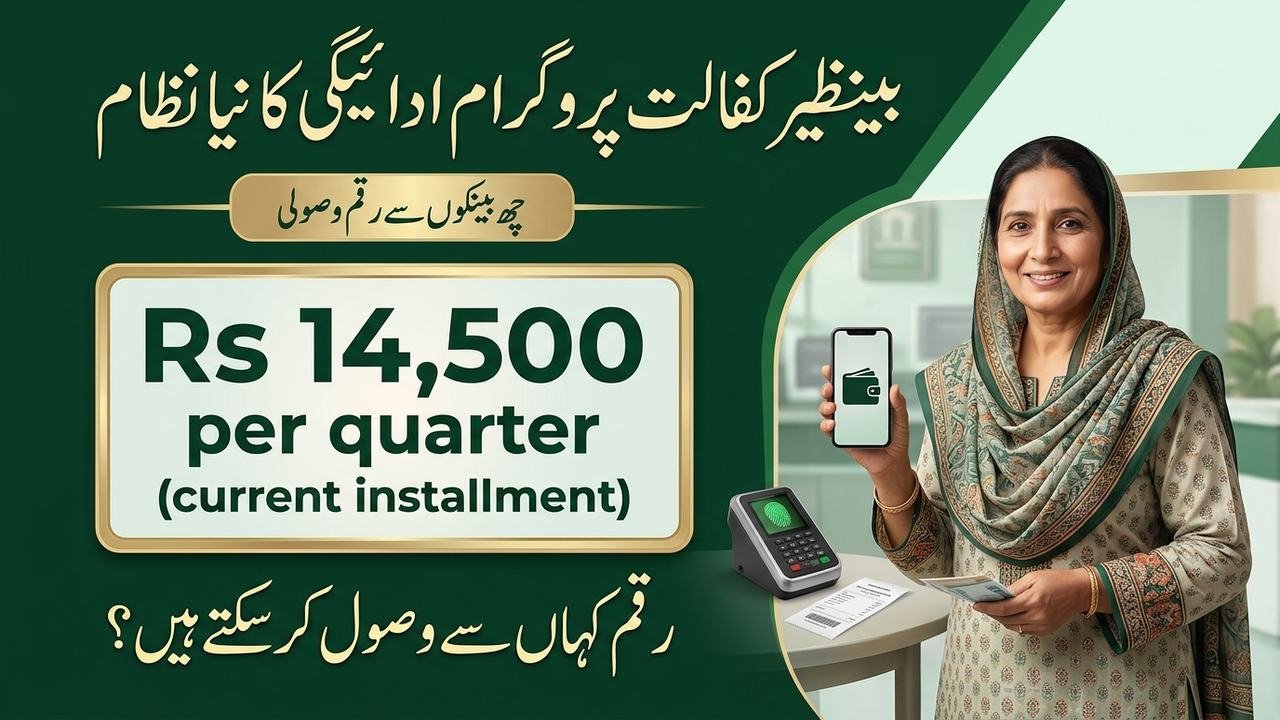
Women receiving financial help under the Benazir Income Support Programme have received an important update about how they will collect their next payment. The BISP interoperability payment system lets a beneficiary withdraw her quarterly installment from an authorised retailer of any of the programme’s six partner banks, in any city, instead of being tied to one bank or one city. The change is part of the programme’s move towards digital, wallet-based payments.
BISP Chairperson Senator Rubina Khalid explained the new arrangement during a live e-Kacheri held at the programme’s headquarters in Islamabad on 4 November 2026. She said the system is designed to make payments safer and more transparent, and to give women greater freedom over where and when they collect their money. The payment itself has not changed: the current quarterly installment for October to December 2026 remains Rs 14,500 for eligible beneficiaries.
Point
Detail
Announcement
4 November 2026, live e-Kacheri, Islamabad
Programme
Benazir Kafalat Programme
New system
Interoperability in digital wallet payments
Partner banks
Six, across Pakistan
Current installment
Rs 14,500 per quarter
Payment alert
SMS on the registered mobile number
Helpline
0800-26477
What Is the Interoperability System?
Interoperability means that different banks and payment networks work together, so a beneficiary is not locked to a single provider. Under the old practice, many women had to use a particular bank’s retailer or a payment point in a particular city. Under the new system, that restriction is removed: once the payment is in the beneficiary’s wallet, she can withdraw it from an authorised retailer of any participating bank, in any city, on any day.
One wallet, many retailers: the payment goes into the beneficiary’s Social Protection Wallet, linked to her free Benazir SIM.
No city restriction: a woman travelling to another city can use an authorised retailer there, without returning to her home district.
No single-bank restriction: the retailer does not have to belong to the bank that issued her SIM or wallet.
Switching behind the scenes: the 1LINK switching mechanism connects the participating banks at agent level, so the withdrawal is recognised across the network.
Basic phone is enough: a smartphone is not required; the wallet and its SMS alerts work on a basic mobile phone as well.
Agents continue: because bank branches do not exist in every area, authorised agents of the partner banks will continue to pay beneficiaries, and the banks remain accountable to BISP for those agents.
The Six Partner Banks
Six financial institutions form the interoperable network. The list below follows the official announcement reported by the Associated Press of Pakistan. Beneficiaries should note the bank names, because only authorised retailers of these partners are part of the system.
Habib Bank Limited: HBL, one of the largest partner banks in the network.
Bank Alfalah: a major partner bank with retailers across the country.
Telenor Microfinance Bank: the bank behind the Easypaisa wallet service.
Bank of Punjab: the Punjab provincial bank, widely present in the province.
Mobilink Microfinance Bank: the bank behind the JazzCash wallet service.
Wallet brands explained: a Jazz SIM links to a JazzCash wallet and a Telenor SIM links to an Easypaisa wallet, which is why some updates mention JazzCash and Easypaisa instead of the bank names.
Only authorised retailers: a shop that is not an authorised retailer of one of these six partners is not part of the system, even if it claims otherwise.
The payment process has a clear order, and beneficiaries should follow it step by step. Visiting a retailer before the payment message arrives is the most common cause of wasted trips and failed attempts.
Step 1, transfer: BISP transfers the quarterly installment into the beneficiary’s wallet account.
Step 2, SMS alert: the beneficiary receives an SMS on her registered mobile number confirming that the payment has arrived.
Step 3, visit a retailer: after the SMS, she visits a nearby authorised retailer of any of the six partner banks.
Step 4, biometric check: she completes biometric verification in person and collects her cash.
Step 5, confirmation SMS: after withdrawal, a second confirmation message is sent with the transaction details, which she should save.
Step 6, count and keep proof: she counts the full amount at the counter before leaving and keeps the receipt and both messages safe.
Do not go early: do not visit a payment point or trust anyone claiming the installment has been released until the official payment SMS arrives.
What Was Announced at the 4 November E-Kacheri
The 4 November 2026 e-Kacheri was a live session at BISP headquarters in Islamabad, broadcast through the programme’s official Facebook account. Chairperson Rubina Khalid spoke directly with beneficiaries, heard their complaints about financial assistance and payment problems, and directed officials to resolve the complaints on priority and submit prompt reports.
Main announcement: interoperability in digital wallet payments, so women can withdraw from authorised retailers of the six partner banks anywhere in Pakistan.
Purpose stated: the digital wallet initiative was launched to improve the security and transparency of payments to women beneficiaries.
SIM safety warning: beneficiaries were warned not to obtain or activate SIM cards through franchises, retailers, or unauthorised individuals; SIM activation is done by the mobile operator’s representatives at designated BISP locations only.
Phone safety warning: women were told never to hand their mobile phone to a retailer, agent, or any other person during the payment process.
Background: the wallet rollout began earlier in 2026 as part of the move to bring beneficiary accounts into the formal banking system, and interoperability was already reported in October 2026; the 4 November session confirmed and explained it again for the coming installment.
Complaints heard: the Chairperson listened to callers from across the country and ordered immediate action on their problems.
Alongside the payment announcement, administrative preparations for the new system have also been reported. These arrangements matter because they decide how quickly a payment complaint is resolved at district level.
Thirty districts: the reported instructions cover all 30 districts of Sindh.
Focal persons: each of the six partner financial institutions has been asked to nominate a focal person for every district.
Their job: the focal persons coordinate with BISP field staff and help resolve banking-related payment problems.
Details requested: the partner institutions have been asked to share their district-level focal person details as soon as possible.
Objective: better coordination between BISP officials, financial institutions, and field teams, so complaints do not wait unnecessarily.
Status note: this district-level arrangement is reported as part of the preparations; beneficiaries should still use the helpline and tehsil office for their own complaints.
What Has Not Changed
A new payment route does not change the basic rules of the programme. Several points are worth stating plainly, because rumours around every payment update tend to add false extras.
Amount unchanged: the current quarterly installment is Rs 14,500; the Rs 18,000 figure from January 2027 is proposed only and is not the current payment.
No release date announced: no exact date for the coming installment has been officially announced; beneficiaries should wait for the official SMS rather than trusting a date circulating on social media.
Eligibility unchanged: the new system changes how money is collected, not who is eligible; eligibility is still decided through the programme’s survey and poverty score.
Registration is free: survey and registration under BISP are free, and no agent can add a name or release a payment early for a fee.
SIM is free and official only: the free Benazir SIM is issued only through a BISP office or camp, against the original CNIC, and is never sold through private shops.
Old payment points remain: authorised agents of the partner banks continue to operate, so women without a nearby bank branch can still collect their payment.
Safety Rules Every Beneficiary Must Follow
Every change in the payment system brings a wave of fake messages and agents offering early withdrawal for a fee. The safety rules below come directly from the official guidance given with the announcement.
Keep your phone with you: never hand your registered mobile phone to a retailer, agent, or stranger.
Save both messages: keep the payment arrival SMS and the post-withdrawal confirmation SMS; together they are your record if a dispute arises.
Trust only 8171: genuine BISP messages come only from 8171, not from private mobile numbers.
Pay no fee: no retailer or agent may demand an extra fee for releasing your installment; report any deduction at once.
Count before leaving: count the full amount at the counter and match it with the receipt.
Use official channels: report deductions, failed withdrawals, or fraud through the helpline or the nearest tehsil office, never through a middleman.
Before travelling to a retailer, check whether your payment is actually ready. This single habit saves transport cost and protects you from failed attempts.
Send your CNIC to 8171: SMS your CNIC number to 8171, the only official BISP SMS number, to check your status.
Check the official portal: visit the official portal at 8171.bisp.gov.pk for status information.
Visit the tehsil office: the nearest BISP tehsil office can confirm your record and guide you if the status is unclear.
Keep your CNIC ready: carry your original CNIC for every check and every visit.
The BISP interoperability payment system is a genuine improvement for beneficiaries: one wallet, six partner banks, authorised retailers in any city, SMS alerts at both ends of the transaction, and district-level coordination to resolve complaints faster. The current installment remains Rs 14,500, no exact release date has been announced, and the safest course is simple: wait for your own payment SMS, visit only an authorised retailer with your original CNIC, count your cash, save both messages, and never pay anyone for your own payment. If anything goes wrong, the helpline and the tehsil office are the only channels you need.
FAQs
What is the BISP interoperability payment system? It lets beneficiaries withdraw their wallet payment from an authorised retailer of any of the six partner banks, in any city, instead of being tied to one bank or one city.
Which six banks are part of the system? HBL, Habib Microfinance Bank, Bank Alfalah, Telenor Microfinance Bank, Bank of Punjab, and Mobilink Microfinance Bank.
Do I need a smartphone for the new system? No. The wallet and its SMS alerts work on a basic mobile phone as well.
Has the exact date of the next installment been announced? No. Wait for the official payment SMS on your registered mobile number before visiting a retailer.
What is the current installment amount? Rs 14,500 per quarter for October to December 2026; Rs 18,000 from January 2027 is proposed only.
Shahzad Sahil is the editor of lahorejobs24.com, covering government jobs, private jobs, bank jobs, results and education news for Lahore and Punjab, with information verified from official sources.