When a landowner dies in Punjab, the land does not pass to the heirs by itself. The official record must be changed, and that change is called a Punjab Inheritance Mutation 2026, known in Urdu as wirasat intiqal. Until the mutation is entered and attested, the deceased owner’s name stays in the land record, and the heirs cannot sell, mortgage or divide the land cleanly.
This guide explains what an inheritance mutation is, who can apply, the documents the Punjab Land Records Authority lists, the step-by-step process at the Arazi Record Centre, and the fee in 2026. It also explains the three-month reporting rule and the mistakes that delay most family cases. Fees and procedures can change, so always confirm the amount on your own challan before you pay.
Item
Detail
Process
Inheritance mutation (wirasat intiqal)
Authority
Punjab Land Records Authority (PLRA), Arazi Record Centre
Where to apply
Any Arazi Record Centre (ARC) in Punjab
Report within
3 months of acquiring the right by inheritance
Service charge
Rs 1,200 standard mutation (reported, FY 2026-27 schedule)
Law
Punjab Land Revenue Act, 1967, section 42
What Wirasaat Intiqal Is and Why It Matters
An inheritance mutation is the entry that replaces a deceased owner’s name with the names of the legal heirs in Punjab’s land record, each heir with a share. The mutation does not itself create ownership, but without it the heirs’ names never appear in the record, and every later step, from a sale to a bank loan, becomes difficult or impossible.
Updates the record: The mutation moves the land from the deceased owner’s name into the names of the legal heirs in the revenue record.
Each heir gets a share: The entry records every legal heir, sons and daughters alike, with the share each one holds.
Needed before a sale: A buyer whose name is not entered in the revenue record will face difficulty selling, mortgaging or defending possession later.
Different from a sale: A sale needs a registered sale deed before the Sub-Registrar, while an inheritance mutation is based on death and heirship, not on a purchase.
Oral transfers banned: Oral sale mutations are banned in Punjab from January 2026, but inheritance cases remain allowed on oral and family proof.
One record, one proof: After attestation, the updated Fard is the proof that the record has changed, not a verbal assurance from any office.
Who Can Apply and the Three-Month Rule
Any one legal heir can start the process, and the whole family does not need to travel to the centre together. The law still sets a clear deadline for reporting the inheritance, so families should act promptly rather than waiting for a dispute to force the issue.
Any legal heir: Any one legal heir can approach the Arazi Record Centre with the required documents, according to the PLRA’s own FAQ.
Report within three months: A person who acquires a right in an estate by inheritance must report it within three months of the acquisition, under sections 42(1) and 42-A of the Land Revenue Act, 1967.
Minor heirs: For a minor heir, the guardian or the person in charge of the minor’s property makes the report.
Where records are computerised: The report goes to the Arazi Record Centre where the records are computerised, otherwise to the Patwari of the estate.
All heirs included: Every legal heir must be listed, including daughters, because leaving one heir out invites a dispute and a challenge later.
Delay has a cost: If the Revenue Officer makes no order within three months of the report, he must report the delay to the Collector, under section 42(10) of the Act.
The PLRA’s own FAQ lists six items for an inheritance mutation at an Arazi Record Centre. Gather all of them before you visit, because a missing document is the most common reason a file is sent back on the first day.
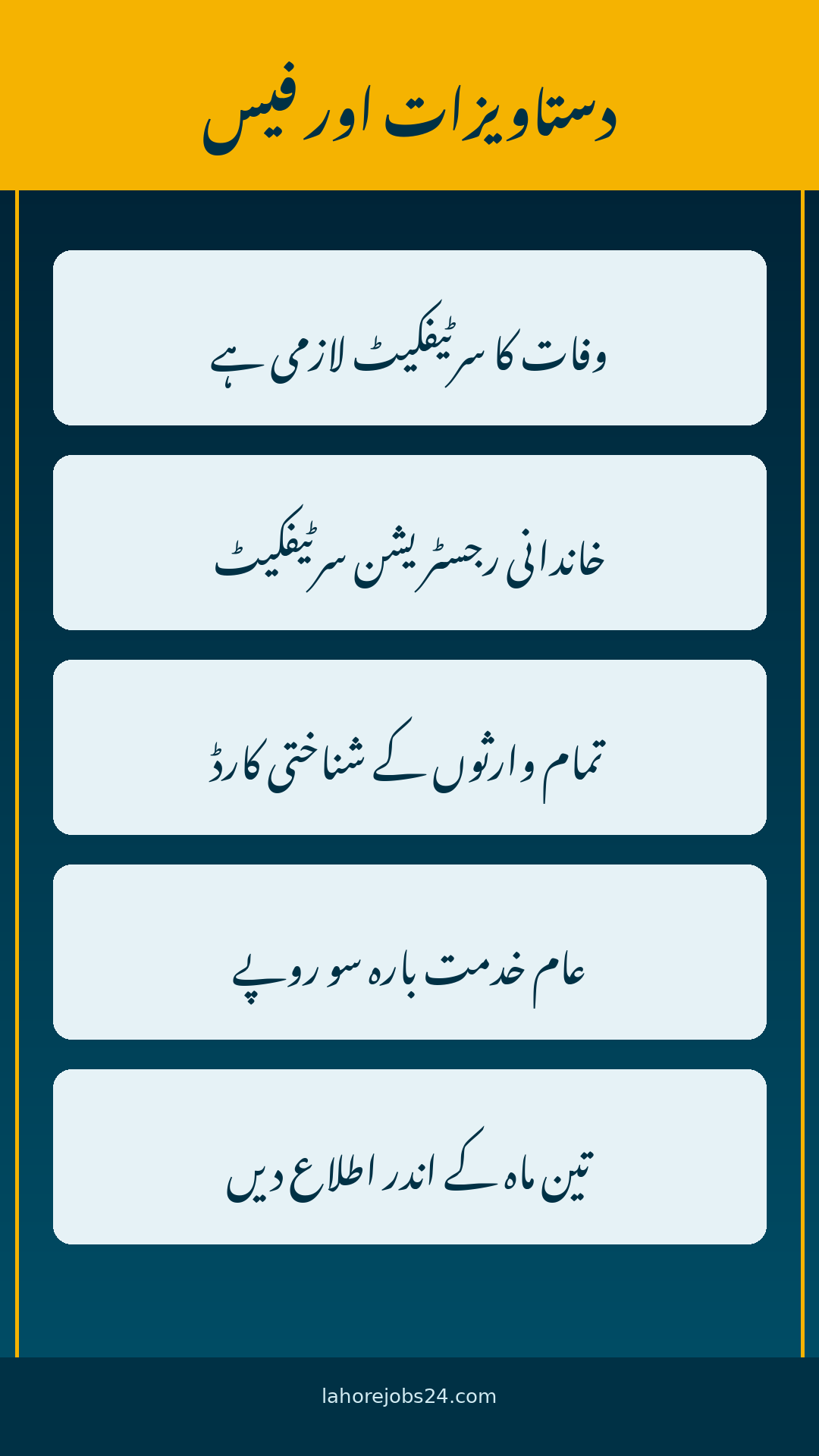
Death certificate: The death certificate of the deceased owner, issued by the Union Council and recorded with NADRA.
Family Registration Certificate: The FRC form from NADRA, showing the family tree of the deceased owner.
Affidavit: An affidavit made by the applicant heir, as listed in the PLRA’s document list.
Property details: The property details, including the khewat and khasra numbers and the mauza, taken from a fresh Fard.
CNIC copies of all heirs: CNIC copies of every legal heir, sons and daughters alike.
Application to the ADLR or LRO: A written application in the name of the Assistant Director Land Records or the Land Record Officer.
No succession certificate on the list: The PLRA’s document list does not include a succession certificate, although some other guides say a court certificate is needed, so confirm the requirement at your own centre before you start.
Step-by-Step Process at the Arazi Record Centre
The process has three clear stages: entry of the mutation, verification of the family tree, and attestation by the Revenue Officer. Knowing the stages helps you follow your file instead of waiting blindly.
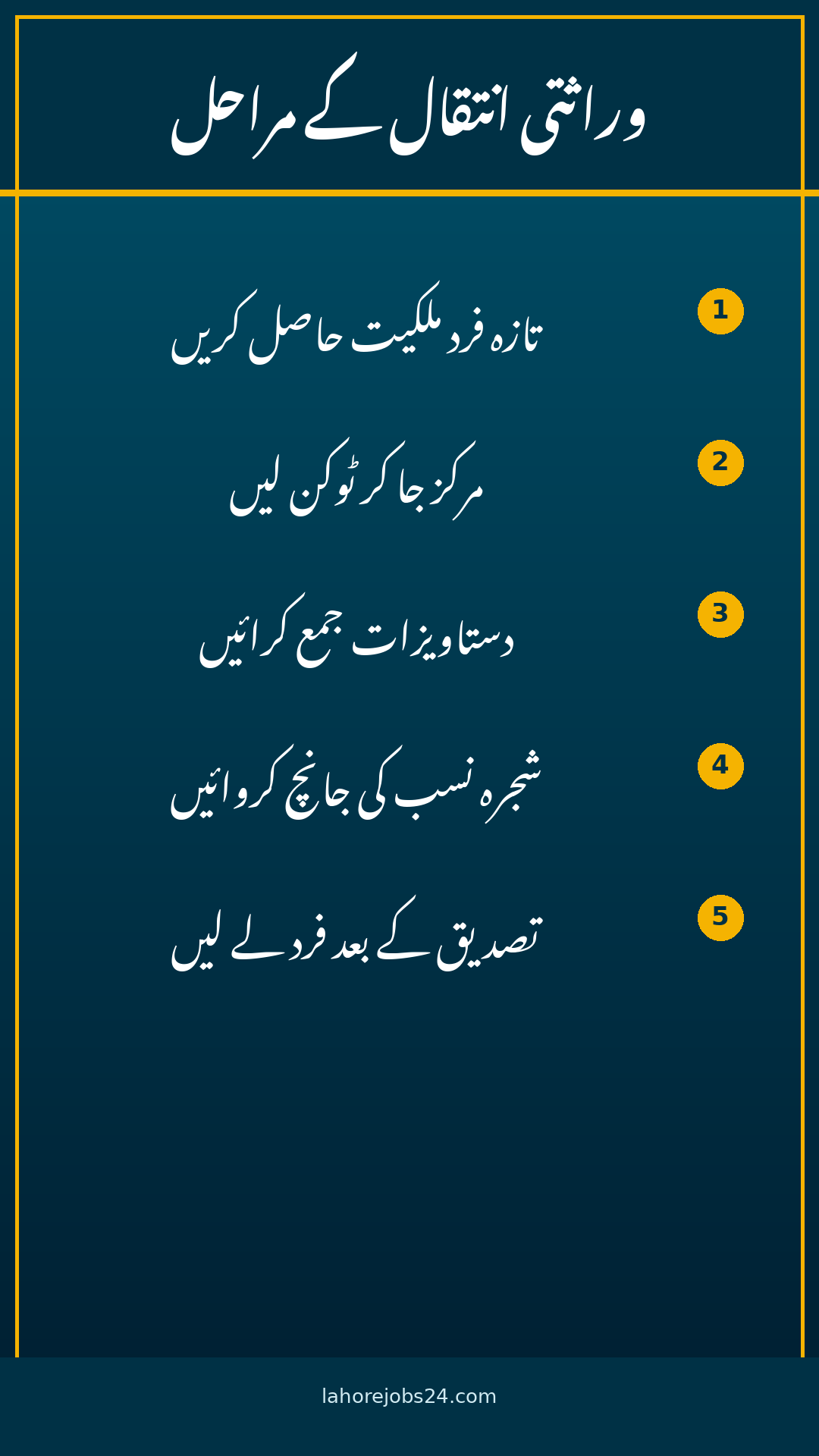
Get a fresh Fard first: Obtain a fresh Fard-e-Malkiat from the Arazi Record Centre yourself, dated within the last few days, and check the owner name and the khewat and khasra numbers.
Register at the reception: At the ARC reception, register your CNIC and give your photo and fingerprints for a token.
Submit the documents: When your token is called, hand the documents to the service centre official, who enters the mutation in the system.
Entry of the mutation: The mutation is entered in the record, which is the first of the three stages in the PLRA’s own FAQ.
Shajra Nasab verification: The file goes to the field revenue staff, who verify the Shajra Nasab, the family tree, against the revenue record.
Attestation at the ARC: After the field verification report arrives, the Revenue Officer attests the inheritance mutation at the Arazi Record Centre.
Confirm with a fresh Fard: After attestation, request a fresh Fard and check that your names now appear as the recorded owners, because the updated Fard is the real proof.
The fee question confuses many families, because old percentage figures for sale mutations are often quoted for inheritance cases by mistake. The PLRA’s schedule for the financial year 2026-27, notified on 8 July 2026, lists fixed service charges for mutations, and the old 3 per cent and 1 per cent figures apply to an oral sale mutation, not to an inheritance.
Service
PLRA service charge
Mutation (other than banks and express service)
Rs 1,200 (reported)
Mutation entered through banks
Rs 2,100 (reported)
Mutation through express service
Rs 11,200 (reported)
Government fee on top
Not confirmed, ask the ARC for the full amount
Schedule does not name inheritance: The FY 2026-27 schedule does not name inheritance mutations separately, so the Rs 1,200 standard figure is reported here as the general mutation charge, and the Board of Revenue’s government fee on top is not confirmed.
Pay only the challan amount: Pay only what the ARC challan shows, at the Bank of Punjab counter or through PSID online, and keep the receipt.
Sale fees do not apply: The old 3 per cent mutation fee and 1 per cent district council fee that the PLRA lists apply to a sale, not to an inheritance, so do not pay them for a wirasat case.
Express service costs more: The express service charge of Rs 11,200 is the fast-track option, and most families do not need it.
Ask before you start: Ask the ARC for the full amount, including any government fee, before you begin, so no surprise charge appears halfway through.
Common Mistakes and How to Avoid Them
Most inheritance mutation cases stall for preventable reasons. A little care at the start protects the family from disputes that can last for years.
Leaving out an heir: Never leave a daughter or any other legal heir off the list, because an excluded heir can challenge the mutation later.
Old Fard: Do not rely on the seller’s or a relative’s old Fard; obtain a fresh Fard yourself from the Arazi Record Centre and match the owner name and numbers.
Paying a middleman: Do not pay any agent or tout who promises a fast mutation, and pay only the amount on the official challan.
Skipping the final check: Never assume the mutation is complete on a verbal promise; check the updated Fard yourself to confirm your names are in the record.
Waiting too long: Report the inheritance within three months, because delay invites competing claims and makes verification harder.
The Punjab Inheritance Mutation 2026 is a straightforward process when the family acts early: any one legal heir can approach any Arazi Record Centre with the death certificate, the Family Registration Certificate, an affidavit, the property details, CNIC copies of all heirs and an application to the land record officer. The mutation is entered, the family tree is verified by field staff, and the Revenue Officer attests it. Report within three months, pay only the challan amount, and confirm the result with a fresh Fard. For the official land record services, visit punjab-zameen.gov.pk.
FAQs
What is wirasat intiqal in Punjab? It is the inheritance mutation that moves a deceased owner’s land into the names of the legal heirs in Punjab’s land record, each heir with a share.
What documents are needed for an inheritance mutation? The death certificate, the NADRA Family Registration Certificate, an affidavit, the property details, CNIC copies of all legal heirs, and an application to the Assistant Director Land Records or Land Record Officer.
What is the fee for an inheritance mutation in Punjab? The PLRA’s FY 2026-27 schedule lists Rs 1,200 for a standard mutation, Rs 2,100 through banks and Rs 11,200 for express service, as reported. The schedule does not name inheritance separately, and the government fee on top is not confirmed, so ask your centre for the full amount.
How long does an inheritance mutation take? There is no fixed number of days in the public record. The mutation is entered, the family tree is verified by field staff, and then it is attested. If the Revenue Officer makes no order within three months of the report, he must report the delay to the Collector.
Can one heir apply for the mutation alone? Yes. Any one legal heir can approach the Arazi Record Centre with the documents, but every legal heir must be listed in the mutation.
Is a succession certificate needed for wirasat intiqal? The PLRA’s own document list does not include a succession certificate. Some other guides say a court certificate is needed, so confirm the requirement at your own Arazi Record Centre before you start.
Shahzad Sahil is the editor of lahorejobs24.com, covering government jobs, private jobs, bank jobs, results and education news for Lahore and Punjab, with information verified from official sources.