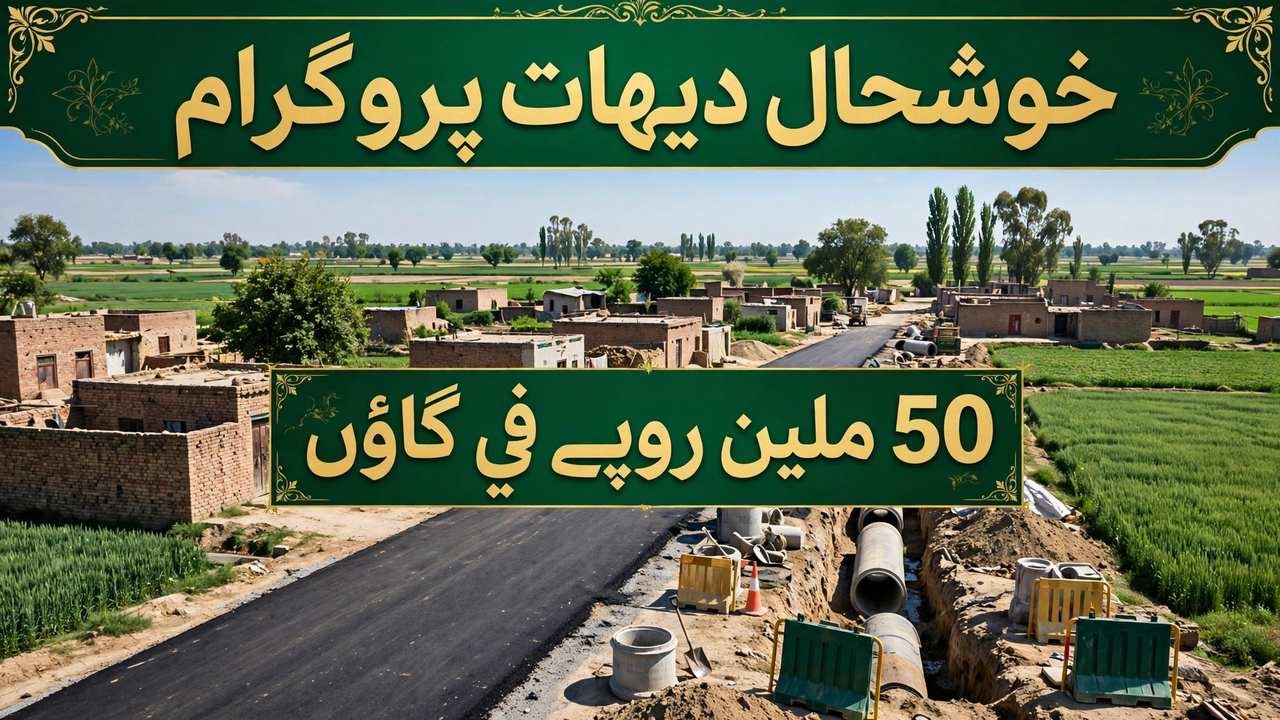
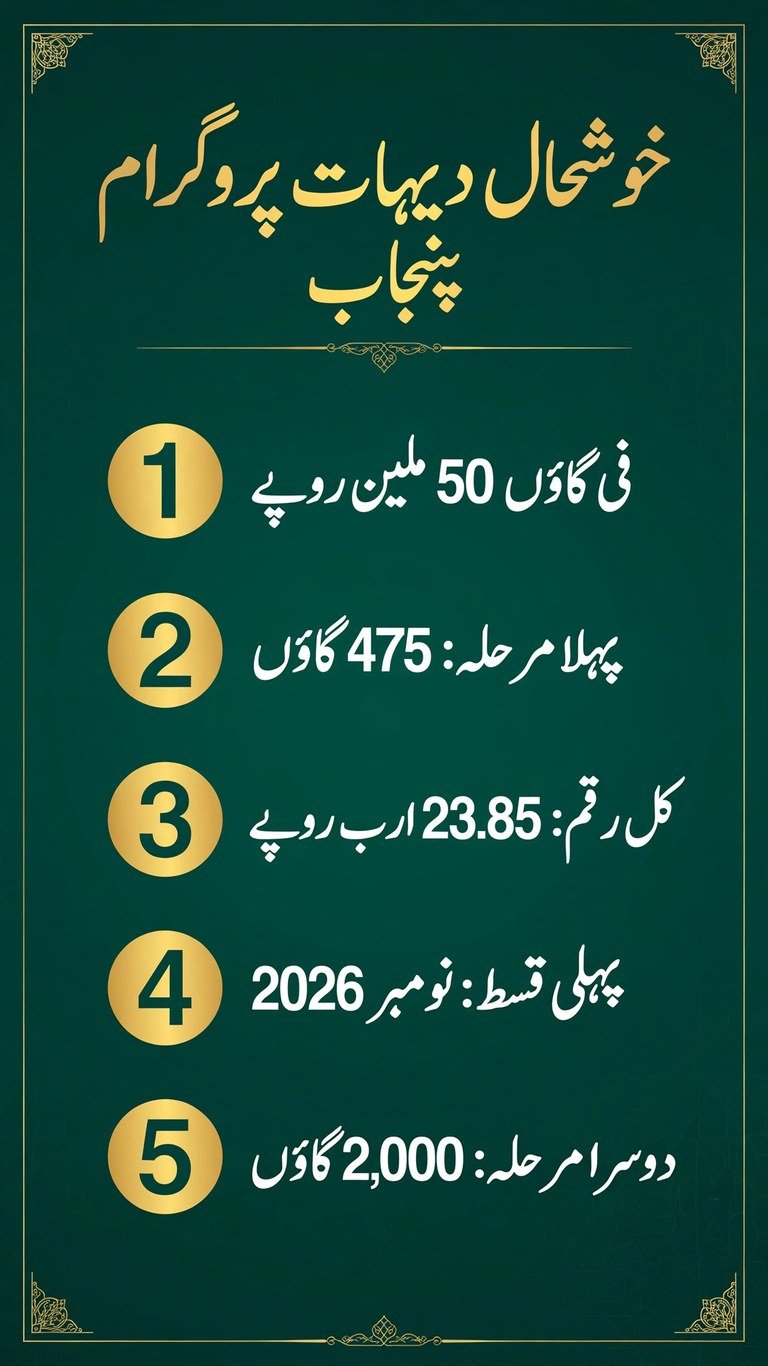
For most villages in Punjab, the walk to school still means muddy lanes in the rains and dust in the dry months — but that is about to change. On 14 November 2026, Chief Minister Maryam Nawaz Sharif approved Rs50 million per village under the Khushhal Dehat Programme, starting with 475 villages, worth Rs23.85 billion, first instalment due in November itself.
Detail
Confirmed Information
Approval date
14 November 2026
Funding per village
Rs50 million
Villages in Phase 1
475 villages across Punjab
Phase 1 allocation
Rs23.85 billion in total
First instalment
Due in November 2026
Phase 2
Development plan sought for 2,000 villages
What Rs50 Million Per Village Will Build
The money pays for three things in each village: paved streets, drainage and a formal sewerage system. The Chief Minister says village and city development will now be the same: “Whether a village or a city, development in Punjab will now be uniform.”
Paved streets: every street will be paved, ending monsoon mud and dry-season dust.
Proper sewerage: a formal sewerage system will replace open drains carrying wastewater past homes.
Drainage works: drainage will be laid with the streets, so rainwater and wastewater drain away.
Money for works, not individuals: the grant goes to the village committee, with no per-person payment or household eligibility test.
For a family in one of the 475 villages, that means children to school on a paved street and wastewater carried away in pipes.
How the Programme Grew From 120 Villages to 475
The Khushhal Dehat Programme did not appear overnight: on 20 October 2026 the Chief Minister approved a pilot to develop 120 villages as model villages and decided to introduce the Khushhal Dehat Act 2026. In Rawalpindi, the administration was directed in early November 2026 to finish clean water, sewerage and street projects in 26 model villages. On 14 November, the Chief Minister turned that pilot into a funded first phase: 475 villages at Rs50 million each.
Rs50 million per village; Rs23.85 billion; first instalment November 2026
Phase 2
2,000 villages
Plan sought
Who Will Run the Work and Watch the Money
A grant of Rs50 million per village only works if someone local is answerable for it, so the district Khushhal Dehat Committee will oversee every project, chaired by the Additional Deputy Commissioner (Social Services), with five officials and four private members, joined by Union Council chairmen and sub-engineers. Each village also has its own committee of four public and four government representatives, including the head teacher, Union Council secretary and a Basic Health Unit or Maryam Nawaz Health Clinic doctor.
District committee: the Additional Deputy Commissioner (Social Services) chairs it, with five officials, four private members, Union Council chairmen and sub-engineers.
Village committee: four public and four government representatives, including the head teacher, the Union Council secretary and a BHU or Maryam Nawaz Health Clinic doctor.
Local voice: the Union Council chairman sits on the district committee, so villagers have a named person to raise problems with.
Oversight chain: the Assistant Commissioner heads each village committee, and the Deputy Commissioner supervises them all.
What Villagers Need to Know Right Now
Three things are not yet known: the official list of the 475 villages is unpublished, so no village can yet confirm whether it is included; no per-village project list and no completion deadline have been announced; and the full text of the Khushhal Dehat Act 2026 and its rules is unpublished.
No registration needed: villagers need not apply anywhere — the funding goes to committees, not households.
No portal or helpline: none has been announced, so there is nowhere to apply.
No fee to anyone: anyone asking for money to include a village or household should be treated with caution; the announced route is the district’s Khushhal Dehat Committee.
What to watch next: the first instalment, the official village list, and the 2,000-village second-phase plan.
On 14 November 2026 the Khushhal Dehat Programme moved from a 120-village pilot to a funded first phase for 475 villages, at Rs50 million each and Rs23.85 billion in total, first instalment due in November. A plan for a second phase of 2,000 villages has already been asked for, and for the first-phase villages the prize is simple: paved streets, proper drainage and a formal sewerage system.
Frequently Asked Questions
What is the Khushhal Dehat Programme?
It is a Punjab government village-development programme under Chief Minister Maryam Nawaz Sharif, paying for paved streets, drainage and sewerage in each village. A pilot for 120 model villages was approved on 20 October 2026; on 14 November 2026 Rs50 million per village was approved for a first phase of 475 villages.
How much money will each village receive?
Each covered village is to receive Rs50 million. Phase 1 is worth Rs23.85 billion, with the opening instalment due in November 2026.
Is my village included in the first phase?
The first phase covers 475 villages, but the official list has not been published yet. Until it appears, ask your Union Council chairman, who sits on the district committee.
Do villagers need to apply or register for the programme?
No. Unlike a cash-transfer scheme, this programme pays for village infrastructure, not individual households. There is no application form, portal or eligibility test, and no fee should be paid to anyone claiming to register a village or household.
Who supervises the development work, and when will it start?
The district-level Khushhal Dehat Committee oversees the projects, chaired by the Additional Deputy Commissioner for Social Services, with five officials, four private members, Union Council chairmen and sub-engineers. The first instalment is due in November 2026, so work should begin within weeks; no completion deadline has been announced.
Shahzad Sahil is the editor of lahorejobs24.com, covering government jobs, private jobs, bank jobs, results and education news for Lahore and Punjab, with information verified from official sources.