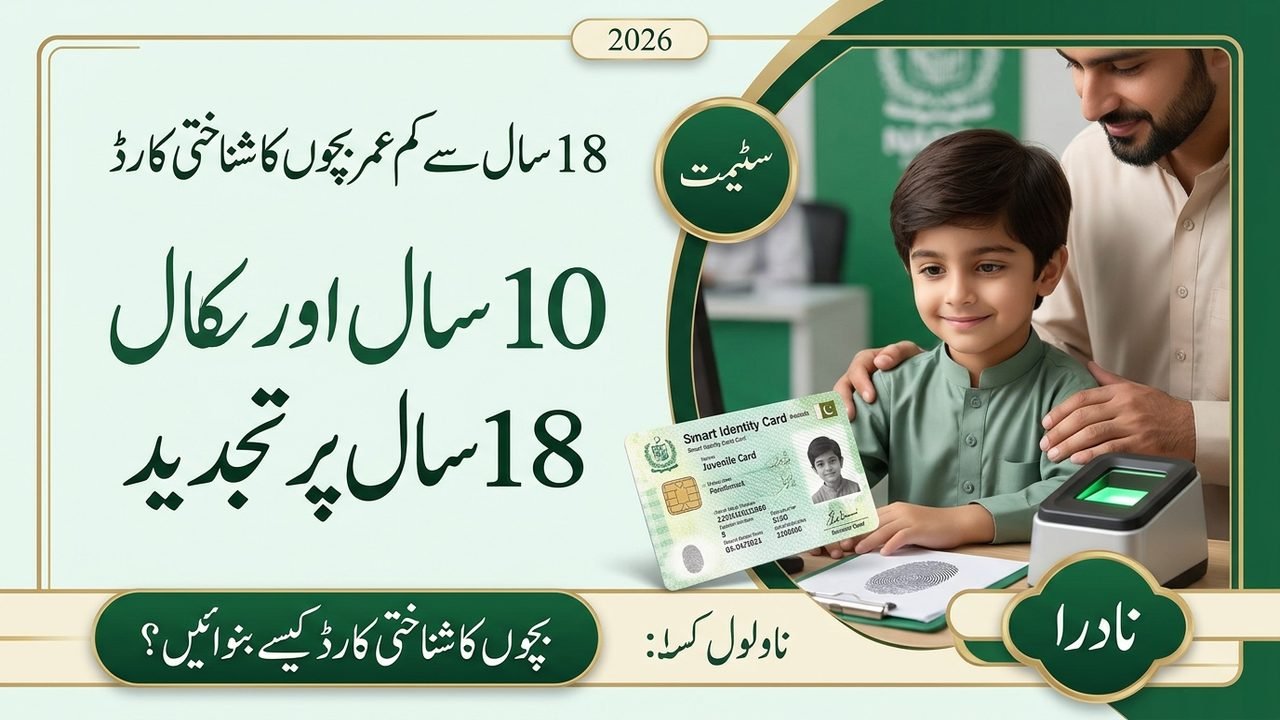
Every Pakistani child under 18 needs an identity document, and the paper B-Form is no longer the only option. The NADRA Juvenile Card is a plastic smart card for children, with a photo and biometrics, and parents can start the application on the Pak ID app. This guide explains the NADRA Juvenile Card 2026 fee position, the documents required, the biometrics and the expiry rules, including the one fact most guides get wrong.
Detail
NADRA Juvenile Card 2026
Who it is for
Pakistani citizens under 18 years of age
Fee
No separate fee listed on NADRA’s fee page — confirm in the Pak ID app or at the centre
Where to apply
Pak ID app or any NADRA Registration Centre
Child’s presence
Mandatory at any age
Validity
Expires on attaining 10 years, and again on attaining 18 years
Smart card for children: The Juvenile Card is a plastic smart identity card issued to Pakistani citizens under 18 years of age, and it is also called the JV Card.
What it carries: It carries the child’s name, date of birth, parent or guardian details, a digital photo, fingerprints and a unique 13-digit identity number linked to NADRA’s national database.
Legal basis: Under Rule 18 of the NADRA (NIC) Rules 2002, every Pakistani citizen who has not attained 18 years of age shall be registered with NADRA and is eligible for a Child Registration Certificate or a Juvenile Card.
Not an adult CNIC: The Juvenile Card is not an adult CNIC, and it expires automatically when the holder turns 18, after which a Smart National Identity Card must be applied for.
Where it is needed: It serves as the national identity document for children under 18 and is used for school admissions, passports, HEC entry tests for under-18 candidates and other official documentation.
Advisory of September 2026: NADRA issued an advisory in September 2026 for parents applying for identity documents for children under 18, covering the Child Registration Certificate, the Juvenile Card and NICOP.
NADRA Juvenile Card Fee 2026
No separate fee line: NADRA’s official fee structure page, checked on 27 September and again on 3 November 2026, has no separate fee line for the Juvenile Card, so no fee figure for it is printed there.
What the fee page does list: The only child document on the fee page is the Child Registration Certificate, at Rs 50 normal with 7 days processing, or Rs 500 executive with 1 day processing, and no urgent tier.
Confirm before paying: Check the exact Juvenile Card charge shown in the Pak ID app or at the NADRA Registration Centre before you pay, because that is the only reliable figure.
Wrong figures in circulation: Some guides quote Rs 750 normal, Rs 1,500 urgent and Rs 2,500 executive with 31, 23 and 9 days, but those figures match the Smart CNIC fee and are not confirmed for the Juvenile Card on NADRA’s own fee page.
Do not pay an agent: Pay only the amount shown in the official app or at the NADRA counter, and never pay a middleman who quotes a fee of his own.
First CNIC at 18: For comparison, a first-time standard CNIC at 18 is free on the normal track, at Rs 1,150 urgent and Rs 2,150 executive, which is a separate document from the Juvenile Card.
Birth certificate: The child’s computerised birth registration certificate, issued by the Union Council, Municipal Committee or Cantonment Board, is the one document NADRA lists for a new Juvenile Card.
Births abroad: For a child born outside Pakistan, bring the detailed birth certificate or the S-1 Form instead of a Union Council certificate.
Parents’ CNICs: NADRA’s page does not list them, but the card records the parents, so take both parents’ original CNICs with you.
B-Form if issued: If the child already has a Child Registration Certificate, known as the B-Form, carry the original as well.
School certificate: For a child aged 10 or above without a B-Form, a school certificate is also asked for, along with the birth certificate and the parent’s CNIC.
Originals only: Always carry original documents, because photocopies alone are usually not accepted at the centre.
Parent or guardian present: The application must be submitted in the presence of the child’s father, mother or legal guardian at a NADRA Registration Centre.
How to Apply for a Juvenile Card
Step 1 — Start online or visit: You can start on NADRA’s Pak ID mobile app, or go straight to a NADRA Registration Centre, and the app takes your details and documents at home.
Step 2 — Create an account: Download the official Pak ID app from Google Play or the App Store, create an account or sign in with your CNIC, and select the Juvenile Card service.
Step 3 — Take the token: At a centre, pay the token fee and obtain a token first, then wait for your turn at the counter.
Step 4 — Child present: The child must attend in person at any age, because the photograph and biometrics are captured on the spot.
Step 5 — Biometrics and photo: The child’s photograph, fingerprints and other biometric and personal information are recorded at the centre.
Step 6 — Verification: The parent or legal guardian is verified, data is entered, and an approval officer completes the fingerprint verification.
Step 7 — Track the application: Track the application through the Pak Identity system with the tracking ID given at the centre.
Centre visit still needed: Even when the application is started on the Pak ID app, the child’s photo and biometrics may still need a centre visit, so plan for one.
Up to 10 years: For a child up to 10 years old, NADRA captures a photograph and an iris scan, and the card expires when the child attains 10 years.
10 to 18 years: For a child aged 10 to 18, NADRA captures a photograph, fingerprints and an iris scan, and the card expires when the holder attains 18 years.
Renewal at 10: When the child turns 10, apply for a fresh Juvenile Card with fingerprints, because the earlier card is no longer valid.
Expiry at 18: Once the child turns 18, the Juvenile Card expires automatically, and the holder must apply for a Smart National Identity Card.
Fingerprints develop with age: Biometric capture becomes more reliable after age 10, because fingerprints develop more clearly by then.
Keep the record updated: NADRA has advised parents to make sure their children have an updated Child Registration Certificate or Juvenile Card with the required photograph and biometric information.
Juvenile Card vs B-Form: What Parents Should Know
B-Form is paper: The Child Registration Certificate, known as the B-Form, is a paper certificate that registers the child with NADRA and gives the child a 13-digit number.
Juvenile Card is plastic: The Juvenile Card is a plastic smart card with a photo and biometrics, and it works as a stand-alone identity document for the child.
Both are valid: Both documents are identity documents for children under 18, and a child can hold either, but the Juvenile Card is the stronger proof of identity because it carries biometrics.
B-Form comes first: Most parents get the B-Form first, and the Juvenile Card can be applied for after that, using the B-Form and the birth certificate.
Fee difference: The B-Form fee is printed on NADRA’s fee page at Rs 50 normal or Rs 500 executive, while the Juvenile Card has no separate fee line and its charge must be confirmed in the app.
Presence rules differ: For a B-Form, the child’s presence is required only above 3 years of age, or below 3 years when the certificate is for passport purposes, while for a Juvenile Card the child’s presence is mandatory at any age.
Which one to choose: If the child needs an identity card for travel, tests or admissions, the Juvenile Card is the better choice, and if only a registration number is needed, the B-Form is enough.
Smart card for children: The NADRA Juvenile Card is a plastic smart identity card for Pakistanis under 18, with a photo and biometrics, and it expires at 10 and again at 18.
Fee not printed: NADRA’s own fee page lists no separate Juvenile Card fee, so confirm the charge in the Pak ID app or at the centre, and do not trust the Smart CNIC figures quoted by some guides.
Child must attend: The child must be present in person with the computerised birth certificate, and a parent or guardian must be present too.
Start on Pak ID: The application can be started on the Pak ID app, but biometrics still need a centre visit, so plan for one.
FAQs
What is the NADRA Juvenile Card fee in 2026? NADRA’s official fee page lists no separate fee for the Juvenile Card, so the charge must be confirmed in the Pak ID app or at the NADRA centre before paying. The B-Form fee is Rs 50 normal or Rs 500 executive.
What documents are needed for a Juvenile Card? The child’s computerised birth registration certificate from the Union Council, or the detailed birth certificate or S-1 Form for a birth abroad, plus both parents’ original CNICs and the B-Form if one was already issued.
Does the child have to be present for a Juvenile Card? Yes. The child’s presence is mandatory at any age for a Juvenile Card, because the photograph and biometrics are captured at the centre.
When does a Juvenile Card expire? It expires when the child attains 10 years of age, and again when the holder attains 18 years, after which a Smart National Identity Card must be applied for.
What is the difference between a Juvenile Card and a B-Form? The B-Form is a paper registration certificate, while the Juvenile Card is a plastic smart card with a photo and biometrics. Both are valid identity documents for children under 18.
Can I apply for a Juvenile Card online? You can start the application on the Pak ID app or the Pak Identity portal, but the child’s photo and biometrics still need a visit to a NADRA Registration Centre.
Shahzad Sahil is the editor of lahorejobs24.com, covering government jobs, private jobs, bank jobs, results and education news for Lahore and Punjab, with information verified from official sources.