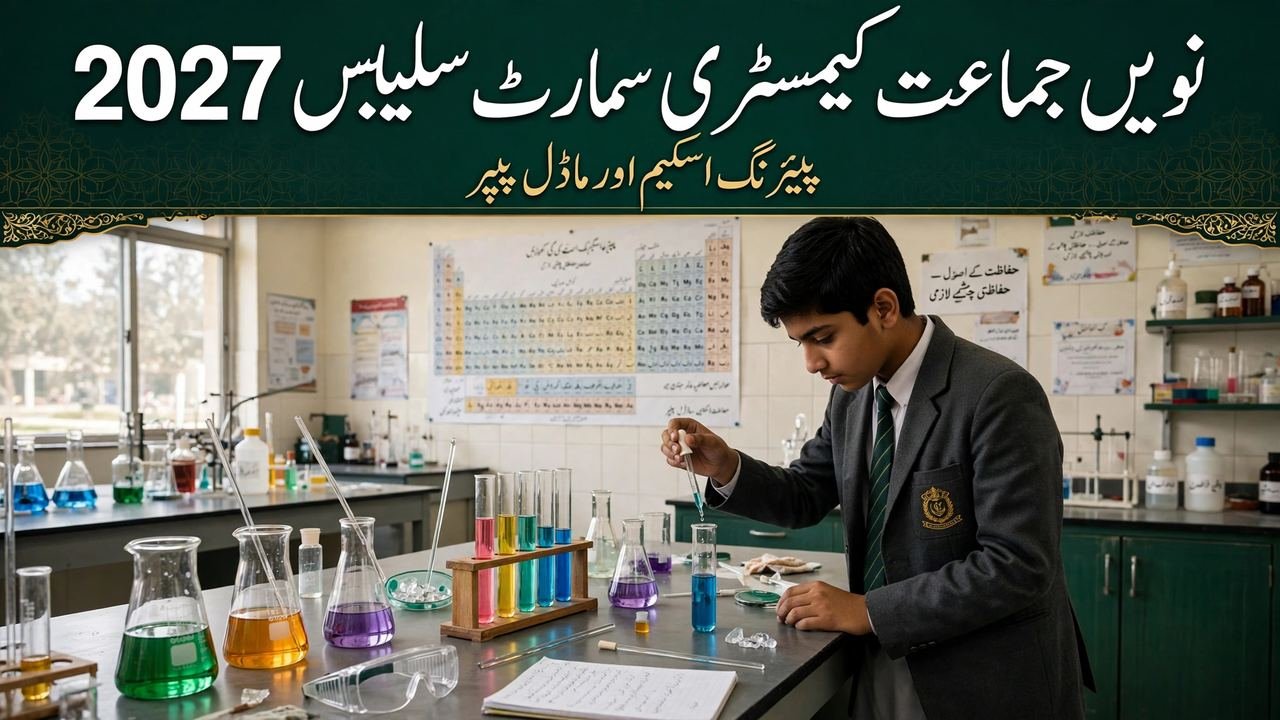
The biggest news in the 9th class Chemistry syllabus for 2027 is what has been removed. PECTAA has notified the 9th Class Chemistry Smart Syllabus 2027 under the Accelerated Learning Programme (ALP), and the official documents show that the last two chapters are deleted in full, while selected topics and exercise questions have been removed from the earlier chapters. The notification, No. PECTAA/C&C Unit/2026/1238, is dated 6 November 2026, and it covers the academic session 2026-27 and the BISE Annual Examination 2027. Reports say the syllabus is the same as last year, so students who prepared from the old smart syllabus are already on the right track.
The Deleted Chapters: What Students Can Skip
Chapters 12 and 13 deleted: According to the ALP tables reported from the official documents, chapters 12 and 13 of Chemistry 9 are deleted in full, so no question will be set from them.
Deleted topics in earlier chapters: The ALP also lists deleted topics and exercise questions chapter by chapter for chapters 1 to 11, covering fundamentals of chemistry, atomic structure, chemical bonding, stoichiometry, energetics and the other retained chapters.
What this means: Students should mark the deleted topics in the textbook and skip them completely, because the board paper will be prepared from the entire textbook except the deleted topics and questions.
Same as last year: Reports say the 9th and 11th class smart syllabus for 2027 is the same as the previous year, and PECTAA has re-notified it for the new session through the 6 November 2026 notification.
Check the official document: The exact deleted topics are listed in the official ALP tables, so students should match the tables with their textbook instead of trusting social media lists.
Chemistry Paper Pattern at a Glance
Paper Part
Marks and Time
Total paper
60 marks
Objective type (MCQs)
12 marks, 15 minutes
Subjective type
48 marks, 1 hour 45 minutes
Total time
2 hours
Short answer questions
30 marks (3 questions of 10 marks each)
Detailed questions
18 marks (attempt any 2 of 3, 9 marks each)
MCQ Distribution: One Mark from Almost Every Chapter
Unlike Physics, where some chapters give two MCQs, Chemistry spreads the objective marks almost evenly. The pairing scheme gives one MCQ from each of chapters 1 to 10, and two MCQs from chapter 11.
Because every retained chapter gives at least one MCQ, skipping a whole chapter costs a mark in the objective part. Students should at least read the definitions, examples and exercise MCQs of every chapter from 1 to 11.
Short and Detailed Questions: The Chapter Map
Q-2 (10 marks): Answer any 5 of 8 short questions. The questions come from chapters 1 to 4, with 1 from chapter 1, 2 from chapter 2, 2 from chapter 3 and 3 from chapter 4.
Q-3 (10 marks): Answer any 5 of 8 short questions. The questions come from chapters 5 to 8, with 3 from chapter 5, 2 from chapter 6, 1 from chapter 7 and 2 from chapter 8.
Q-4 (10 marks): Answer any 5 of 8 short questions. The questions come from chapters 9 to 11, with 3 from chapter 9, 2 from chapter 10 and 3 from chapter 11.
Q-5 (9 marks): A detailed question in two parts, from chapters 1 and 2. Part (a) carries 5 marks and Part (b) carries 4 marks.
Q-6 (9 marks): A detailed question in two parts, from chapters 3 and 7.
Q-7 (9 marks): A detailed question in two parts, from chapters 8 and 10.
Choice in long questions: Students attempt any 2 of the 3 detailed questions, so one weak chapter pair can be avoided in this section.
Model Paper: What the Questions Look Like
The official Chemistry model paper shows the real level of the questions. The objective part has 12 MCQs in 15 minutes, and the subjective part has three short-question groups and three detailed questions.
Atomic structure: The model paper asks about neutrons in Bismuth-210, atomic number and mass number, and the dot and cross formula of nitric acid.
Bonding and states of matter: Questions cover why hydrogen fluoride is a liquid while hydrogen chloride is a gas, and why iodine is solid at room temperature.
Mole and stoichiometry: Students are asked about the mole and Avogadro’s number, molecules in 1.5 g of water, and the chemical formula of barium nitride.
Energetics and equilibrium: Questions cover enthalpy and enthalpy change, why bond breaking is endothermic, glycogen in the body, and dynamic versus static equilibrium.
Periodic table: The model paper asks about the significance of the word periodic, why atomic number arranges the elements, and properties of noble gases.
Organic and environmental chemistry: Questions cover organic versus inorganic compounds, uses of organic compounds, naphtha on heating, environmental chemistry, and harmful effects of carbon monoxide.
Detailed questions: The long questions ask about elements, compounds and mixtures with Bohr’s atomic model, ionic and covalent bond formation with the Arrhenius concept of acids and bases, and variation of atomic radius and ionization energy with harmful air pollutants.
Start with deletions: Mark chapters 12 and 13 and all deleted topics in chapters 1 to 11, so no revision time is wasted on them.
Definitions first: Chemistry short questions are mostly definitions, differences and reasons, so prepare every definition with one example each.
Formulas and equations: Practise chemical formulas, dot and cross formulas and balanced equations, because they appear in both short and detailed questions.
Numerical practice: Mole, Avogadro’s number and mass calculations appear every year, so solve the numerical problems from the retained exercises.
Chapter 4 and 11 focus: Chapter 4 gives 3 short questions in Q-2 and chapter 11 gives 3 short questions in Q-4 plus 2 MCQs, so these two chapters carry the most short-question marks.
Model paper drill: Solve the official model paper in exactly 2 hours, and check every answer against the textbook before the annual examination.
Step 2: Find the Grade 9 Smart Syllabus (ALP) documents for the academic session 2026-27, notified on 6 November 2026 under Notification No. PECTAA/C&C Unit/2026/1238.
Step 3: Download the Chemistry ALP tables, the pairing scheme and the model paper, and match the deleted topics with the textbook.
Step 4: Share the official link with classmates instead of forwarded screenshots, because many screenshots on social media are old or incomplete.
Conclusion
The 9th Class Chemistry Smart Syllabus 2027 gives students a clear advantage: two full chapters are deleted, and the pairing scheme shows exactly how many questions will come from each remaining chapter. The paper is 60 marks in 2 hours, with 12 MCQs, 30 marks of short questions and 18 marks of detailed questions. Students who mark the deletions, prepare definitions and formulas from chapters 1 to 11, and practise the official model paper will find the BISE Annual Examination 2027 much easier than the full book suggests.
Which chapters are deleted in 9th class Chemistry smart syllabus 2027? According to the ALP tables reported from the official documents, chapters 12 and 13 are deleted in full, and selected topics and exercise questions are also deleted from chapters 1 to 11.
What is the total marks of the 9th class Chemistry paper 2027? The Chemistry paper for Grade 9 will consist of 60 marks: 12 marks objective and 48 marks subjective, with a total time of 2 hours.
Is the Chemistry smart syllabus 2027 the same as last year? According to reports, the smart syllabus for 2027 is the same as the previous year. PECTAA re-notified it for the academic session 2026-27 through Notification No. PECTAA/C&C Unit/2026/1238 dated 6 November 2026.
Which chapters carry the most short-question marks in Chemistry 9? Chapter 4 gives 3 short questions in Q-2 and chapter 11 gives 3 short questions in Q-4 plus 2 MCQs, so these two chapters carry the most short-question marks.
Where can I download the official Chemistry smart syllabus? From the official PECTAA curriculum page at pectaa.edu.pk/curriculum-compliance/, under the Grade 9 documents notified on 6 November 2026.
Shahzad Sahil is the editor of lahorejobs24.com, covering government jobs, private jobs, bank jobs, results and education news for Lahore and Punjab, with information verified from official sources.