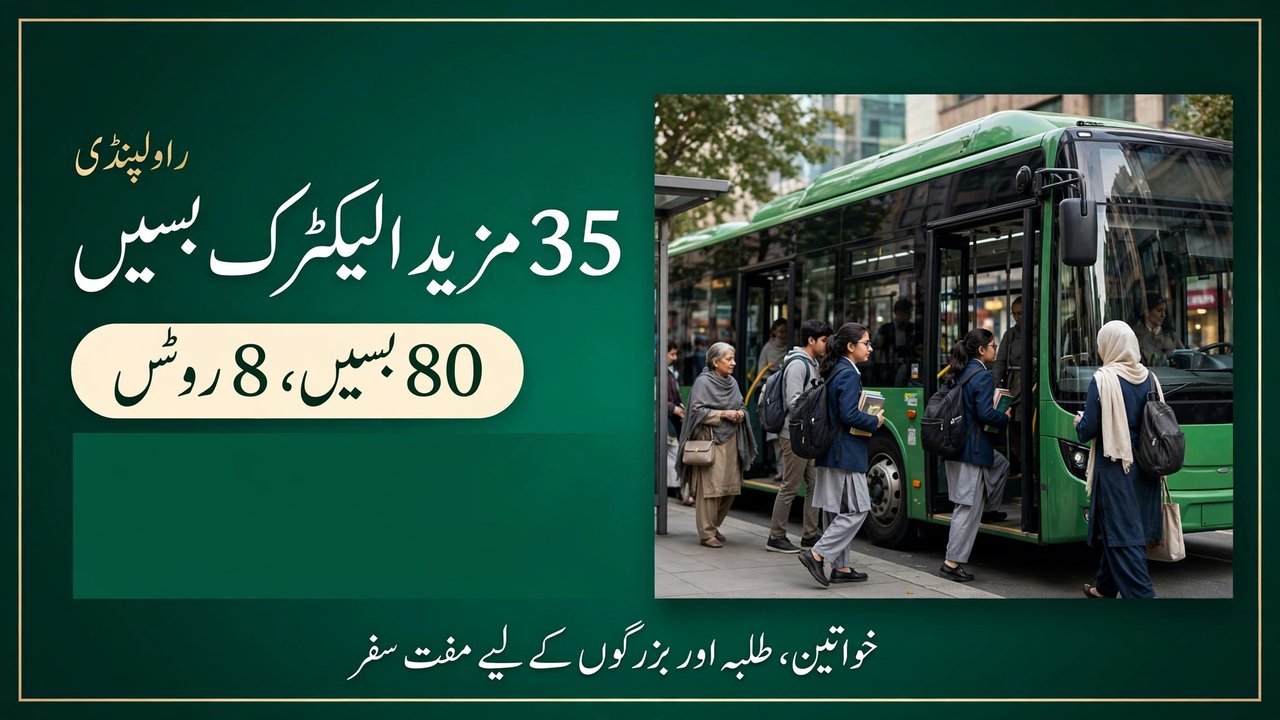
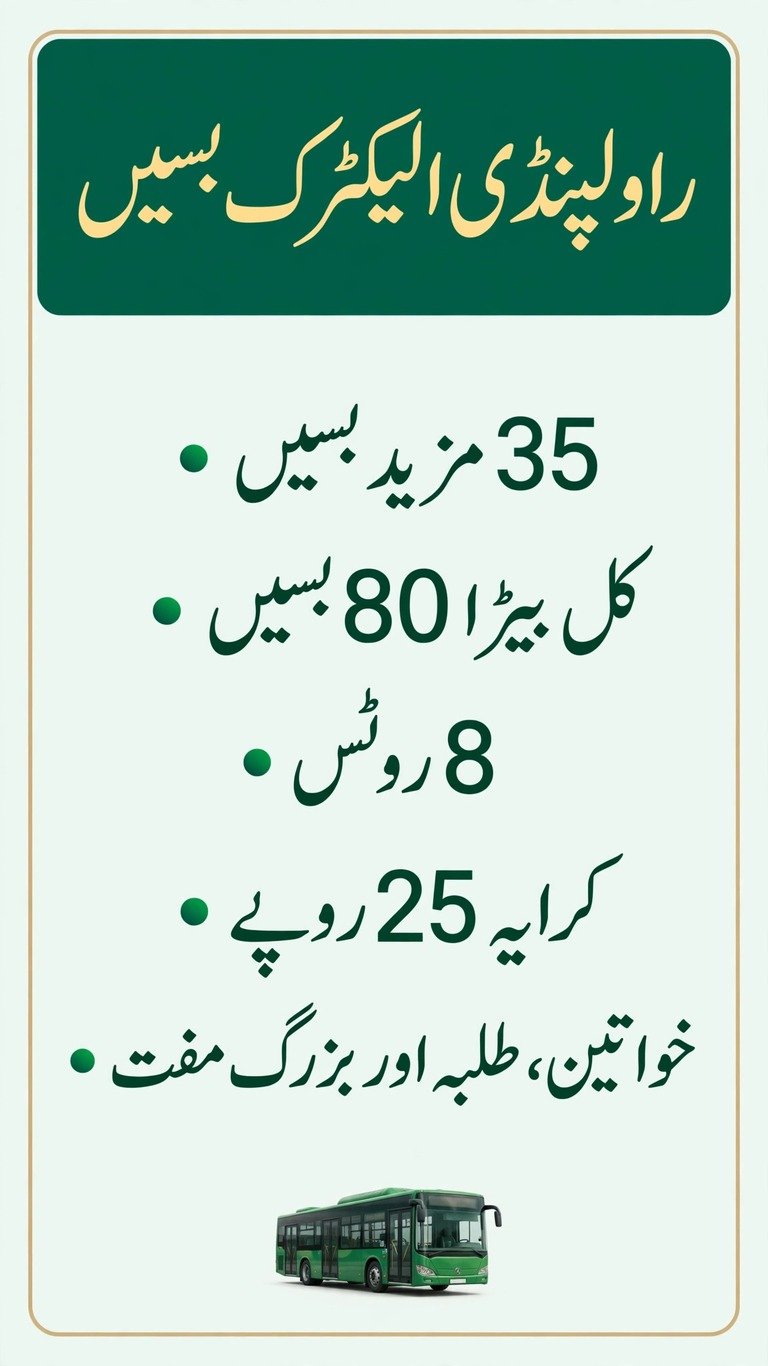
Rawalpindi’s public transport is about to get a major boost. The city has received 35 more electric buses, and they will start running on existing routes from Friday, 14 November 2026. With this addition, the Rawalpindi Electric Buses fleet grows to 80 buses, up from the 45 launched by Chief Minister Maryam Nawaz in November 2025. For daily commuters, the news brings two immediate benefits: more buses on busy routes, and free travel for women, students and senior citizens, while other passengers pay only Rs. 25. The update was reported by ProPakistani on 13 November 2026.
Detail
Update
New buses received
35 additional electric buses
Total fleet now
80 buses
Previous fleet
45 buses, launched November 2025
Service starts
Friday, 14 November 2026
Operational routes
8 routes
New buses on routes now
25 buses
Fare for other passengers
Rs. 25
Free travel
Women, students, senior citizens
The 8 Routes and the Areas They Cover
The new buses will run on the routes where passengers need them most. The Rawalpindi Electric Buses service already connects the busiest parts of the city, and the 25 buses joining service now will be spread across the 8 operational routes according to passenger demand.
Saddar: the city’s main commercial hub, where offices, markets and transport links meet.
Koral Chowk: a key junction for commuters travelling across the city.
Fawara Chowk: one of the busiest chowks in the old city area.
Mandi Mor: a major stop for daily wage earners and traders.
Faizabad: the gateway between Rawalpindi and Islamabad.
Tramri Chowk: an important link for residents of the southern parts of the city.
Kuri Road: serving neighbourhoods along one of the city’s main roads.
Lalarukh Colony: connecting a large residential area with the rest of the city.
Demand-based deployment: the 25 buses will be placed on routes with the heaviest passenger load first.
Existing routes: the new buses join routes that are already running, so there is no waiting for new route planning.
Because the buses join existing routes, commuters will feel the difference from the very first day. More buses on a route means shorter waiting times at stops and less crowding inside the bus, especially during the morning and evening rush hours.
Free Travel for Women, Students and Senior Citizens
The most important part of this announcement for ordinary families is the fare relief. Women, senior citizens and students will travel free on these buses, while every other passenger pays a flat fare of Rs. 25.
Women travel free: women passengers will not pay any fare on the electric buses.
Students travel free: students going to school, college or university can travel without paying.
Senior citizens travel free: elderly passengers can use the buses at no cost.
Flat fare for others: all other passengers pay Rs. 25 per journey.
Daily savings: a student travelling to college and back every day saves the full fare, which adds up to real money over a month.
Safe and comfortable travel: electric buses offer a cleaner, quieter ride than older diesel buses.
More trips, less worry: free travel means families can send children to school and college without worrying about daily transport cost.
For students in particular, the free travel policy removes one of the biggest daily expenses of education. Parents who send two or three children to school and college will feel the relief in the monthly household budget.
Fare, Fleet and Daily Operations
The numbers behind the announcement show how the fleet is being managed. Of the 45 buses launched in November 2025, 40 are currently operational and 5 are kept in reserve. The 35 new buses take the total fleet to 80.
Total fleet: 80 electric buses after the new addition.
Already running: 40 buses from the earlier batch are in daily service.
In reserve: 5 buses are kept ready as backup for maintenance or breakdowns.
Joining now: 25 of the 35 new buses start service on Friday, 14 November 2026.
Joining later: the remaining 10 new buses will join once two suspended routes reopen.
Flat fare: Rs. 25 for passengers who are not in the free-travel categories.
Charging: charging arrangements have been made at the RTA depot on Adamjee Road.
Keeping buses in reserve is a normal part of running a city bus service. It means that if a bus needs maintenance, another one can take its place without cancelling the route, so passengers are not left waiting.
Two Suspended Routes and What Happens Next
Not all of the 35 new buses will be on the road on day one. Two routes on Peshawar Road are currently suspended because of underpass construction work, and the remaining buses will join the fleet when those routes reopen.
Suspended route 1: Saddar to Bhatta Chowk, on Peshawar Road.
Suspended route 2: Marrir Chowk to Motorway Chowk at Chungi No. 26, on Peshawar Road.
Reason for suspension: underpass construction at Race Course Park and Charing Cross.
Buses waiting: 10 of the new buses will join service after these routes reopen.
What commuters should do: passengers on these two routes should keep using their current transport until the routes restart.
The construction work is temporary, and the two routes will return once the underpasses are complete. When they reopen, the full fleet of 80 buses will be available across all routes, including the two Peshawar Road routes.
Charging, Metro Links and the Bigger Picture
The electric buses are part of a wider plan to modernise public transport in Rawalpindi and connect it with the metro network. Charging for the buses has been arranged at the RTA depot on Adamjee Road, so the fleet can be charged and serviced in one place.
Metro feeder service: the electric buses can work as a feeder service for the Metro Bus Service.
Metro connection: the buses connect with the Rawalpindi-Islamabad metro network.
Cleaner air: electric buses produce no tailpipe smoke, which helps keep city air cleaner.
Quieter streets: electric buses run more quietly than diesel buses.
Lower running cost: electricity costs less per kilometre than diesel, which helps keep fares low.
First and last mile: feeder buses help passengers reach metro stations from their neighbourhoods.
A feeder service matters because a metro line alone cannot reach every street. Buses that bring passengers to metro stations, and take them home again, make the whole network useful for far more people.
What Commuters Should Know Before Friday
The Rawalpindi Electric Buses service starts running on Friday, 14 November 2026. Commuters who use the 8 operational routes should be ready for a better service from the first day, while passengers on the two suspended Peshawar Road routes will have to wait a little longer.
Start date: Friday, 14 November 2026, on existing routes.
Check your route: confirm that your route is among the 8 operational routes before you travel.
Carry your student card: students should keep their student card with them to benefit from free travel.
Fare ready: other passengers should keep Rs. 25 ready for the fare.
Expect more buses: waiting times should fall as 25 more buses join the routes.
Suspended routes: the Saddar-Bhatta Chowk and Marrir Chowk-Motorway Chowk routes remain suspended for now.
Stay updated: follow official announcements for news about the reopening of the two suspended routes.
For Rawalpindi’s daily commuters, this is a practical improvement rather than a promise for the future. The buses have arrived, the routes are ready, and the service starts on Friday.
Rawalpindi’s electric bus fleet is growing from 45 to 80 buses, and 25 of the new buses start running on Friday, 14 November 2026, on the 8 operational routes. Women, students and senior citizens travel free, while other passengers pay only Rs. 25. The remaining 10 buses will join when the two suspended Peshawar Road routes reopen after underpass construction. With charging arranged at the RTA depot on Adamjee Road and a possible feeder role for the Metro Bus Service, the Rawalpindi Electric Buses network is becoming a real daily option for thousands of commuters across the city.
Frequently Asked Questions (FAQs)
How many new electric buses has Rawalpindi received?
Rawalpindi has received 35 additional electric buses, taking the total fleet to 80 buses.
When will the new buses start running?
The new buses begin operating on existing routes from Friday, 14 November 2026.
Who can travel free on the Rawalpindi electric buses?
Women, senior citizens and students travel free. Other passengers pay Rs. 25.
How many routes do the electric buses cover?
The buses run on 8 operational routes connecting Saddar, Koral Chowk, Fawara Chowk, Mandi Mor, Faizabad, Tramri Chowk, Kuri Road and Lalarukh Colony.
Why are 10 new buses not joining service yet?
Two Peshawar Road routes, Saddar-Bhatta Chowk and Marrir Chowk-Motorway Chowk at Chungi No. 26, are suspended due to underpass construction at Race Course Park and Charing Cross. The remaining buses will join when these routes reopen.
Where are the buses charged?
Charging has been arranged at the RTA depot on Adamjee Road, Rawalpindi.
Shahzad Sahil is the editor of lahorejobs24.com, covering government jobs, private jobs, bank jobs, results and education news for Lahore and Punjab, with information verified from official sources.