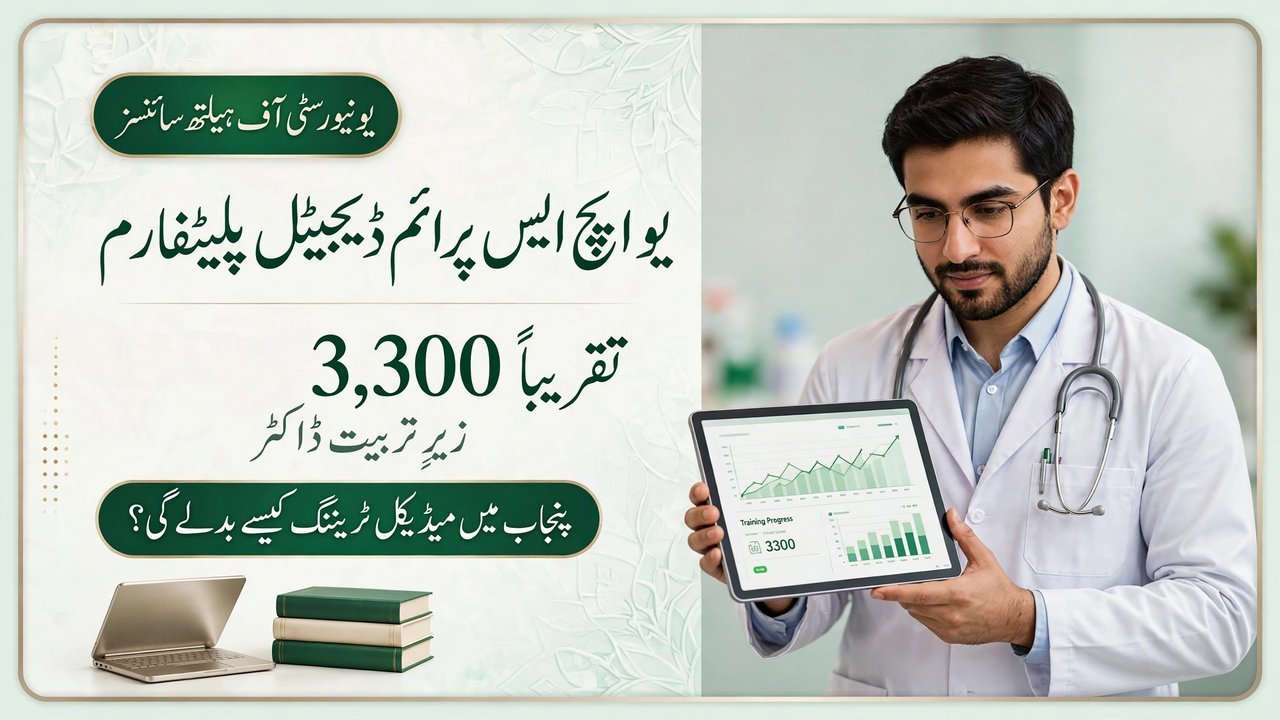
The University of Health Sciences (UHS) has launched the UHS PRIME Digital Platform, a province-wide digital system that will monitor medical education, clinical training and professional competency assessments across Punjab. Inaugurated by Provincial Minister for Specialized Healthcare and Medical Education Khawaja Salman Rafique at UHS, the platform replaces paper logbooks with digital records and brings trainees, supervisors and institutions together in one transparent system. It is one of the most significant reforms in Punjab’s medical training in recent years.
Detail
Information
Platform
UHS PRIME Digital Platform
Full Name
Health Professions Education: Progress, Research, Integrated Monitoring and Evaluation
Launched By
University of Health Sciences (UHS), Punjab
Inaugurated By
Khawaja Salman Rafique, Provincial Minister for Specialized Healthcare and Medical Education
Phase 1 Coverage
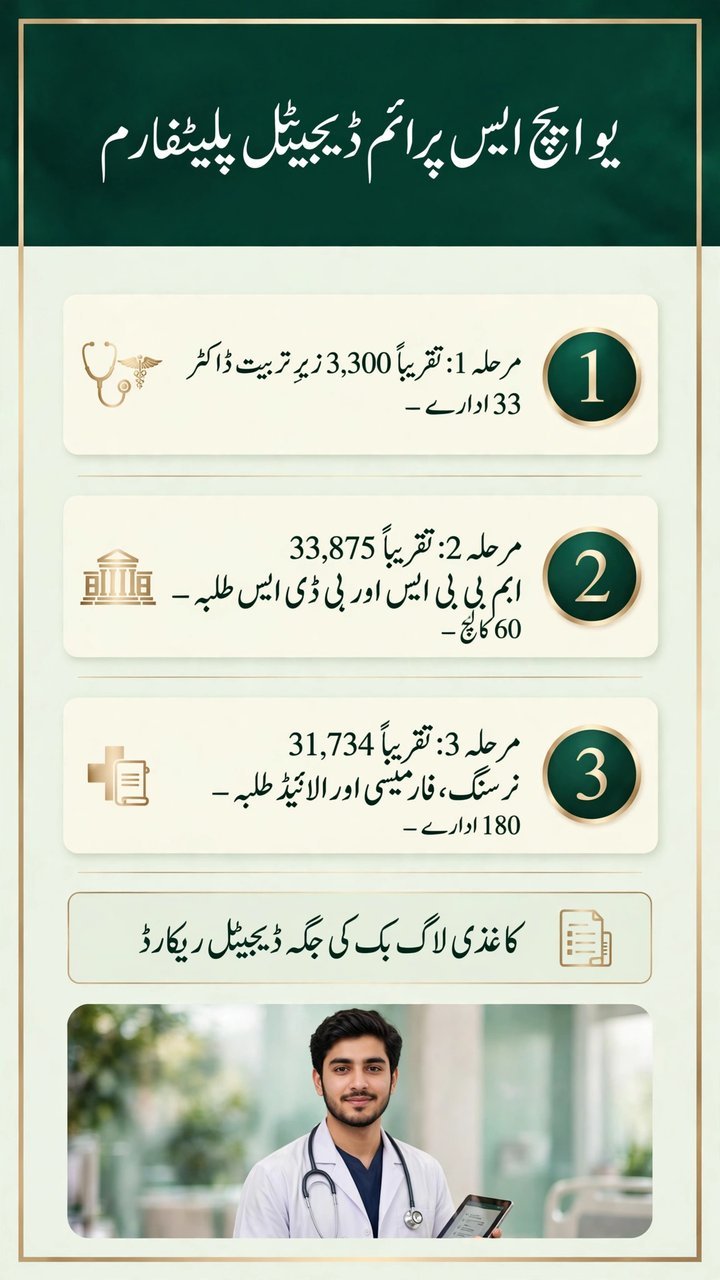
Approximately 3,300 MS, MD and MDS trainees at 33 training institutions
Supervisors
Around 1,100 supervisors to be registered on the portal
PRIME stands for Health Professions Education: Progress, Research, Integrated Monitoring and Evaluation. It is a province-wide digital platform introduced by the University of Health Sciences to integrate the monitoring of medical education, clinical training and professional competency assessments across Punjab. Instead of scattered paper files and manual checks, the UHS PRIME Digital Platform puts the whole training journey of a doctor or health professional into one connected system.
One connected portal: the platform brings trainees, supervisors and institutions together on a single digital system, so training records are no longer kept in separate files.
Province-wide reach: it covers UHS-affiliated training institutions across Punjab, from large teaching hospitals to smaller training centres.
Competency focus: the system shifts health professions education beyond routine record maintenance towards demonstrated clinical competence and verified professional skills, as UHS Vice Chancellor Maj Gen Prof. Sohail Sabir (Retd) explained at the launch.
Continuous oversight: training is monitored as it happens, rather than being checked only at the end of a course or examination.
Data-driven decisions: the information collected on the portal will help pinpoint training gaps and guide evidence-based decisions, according to the provincial minister.
The launch marks a clear move away from the old way of tracking medical training. For years, postgraduate trainees in Punjab have recorded their clinical work in paper logbooks, which are easy to lose, hard to verify and difficult for the university to review at scale. The UHS PRIME Digital Platform changes that by making every case, procedure and assessment part of a verifiable digital record.
Phase 1: Postgraduate Training Goes Digital
The first phase of the UHS PRIME Digital Platform covers postgraduate medical and dental programmes. This is the largest and most complex part of medical training to digitise first, because it involves trainees working in busy hospital wards, operating theatres and clinics across the province. The figures announced at the launch show the scale of this first step.
Trainees covered: approximately 3,300 MS, MD and MDS trainees will come onto the platform in the first phase.
Institutions involved: 33 training institutions across Punjab will take part in Phase 1.
Supervisors registered: around 1,100 supervisors will be registered on the portal to oversee and verify trainees’ work.
Paper logbooks replaced: digital records will document clinical cases, procedures, attendance, rotations, research work and workplace-based assessments.
Supervisor verification: supervisors will verify trainees’ clinical and academic work, share feedback and track their development over time.
Institutional dashboards: dashboards will allow UHS to assess training standards at each institution and identify shortcomings quickly.
For a postgraduate trainee, this means that the work they do every day in the hospital becomes part of an official, checkable record. For the university, it means training quality can finally be compared across institutions using the same data, instead of relying on paper files that arrive months late or not at all.
Assessments and the Learning System
A central part of the UHS PRIME Digital Platform is how it handles assessment. Medical training is not only about attending lectures and completing rotations. Trainees must prove, again and again, that they can examine a patient, perform a procedure and make sound clinical decisions. The platform is built around that idea, with regular assessments recorded digitally throughout the training period.
Quarterly assessments: the portal will incorporate quarterly continuous internal assessments, so progress is reviewed four times a year rather than only at final examinations.
Mini-CEX evaluations: Mini-Clinical Evaluation Exercises will assess trainees during real patient encounters in the workplace.
DOPS assessments: Direct Observation of Procedural Skills (DOPS) will record how safely and correctly a trainee performs clinical procedures under supervision.
Case-Based Discussions: structured discussions of real clinical cases will form part of the workplace-based evaluation on the portal.
Research tracking: the portal will track research progress and maintain records of academic activities alongside clinical work.
Learning management system: PRIME will feature a learning management system, with dashboards at both institutional and university levels.
UHS Director Postgraduate Studies Prof. Muhammad Asif Naveed briefed attendees at the launch on the portal’s functions and its implementation framework. The combination of regular assessment, research tracking and a learning management system means the platform is designed as a complete training environment, not simply a digital filing cabinet.
Phases 2 and 3: The Expansion Plan
Outlining the expansion plan at the launch, Prof. Sohail Sabir said the UHS PRIME Digital Platform will grow in stages until it covers nearly every health professions student in Punjab. The second and third phases extend the platform from postgraduate trainees to undergraduate students and then to nursing, pharmacy and allied health sciences. No launch or rollout dates for Phases 2 and 3 have been announced yet.
Phase 2 scope: the second phase will cover undergraduate MBBS and BDS programmes, along with house-job training for new graduates.
Phase 2 numbers: approximately 33,875 students and house officers from 60 medical and dental colleges will be brought onto the platform in this stage.
Phase 3 scope: the third phase will incorporate Nursing, Pharmacy and Allied Health Sciences programmes.
Phase 3 numbers: around 31,734 students studying at 180 institutions will be covered in the final phase.
No dates announced: no launch or rollout dates for Phases 2 and 3 have been announced, so students in these programmes should wait for an official announcement from UHS.
Three-phase rollout: the platform is being introduced in three phases, beginning with postgraduate training and expanding to undergraduate and allied health programmes.
When all three phases are complete, the platform will cover approximately 68,909 trainees and students across 273 institutions in Punjab. That scale explains why UHS has chosen a phased rollout, starting with the smaller postgraduate group before extending the system to tens of thousands of undergraduate and allied health students.
What PRIME Means for Trainees and Supervisors
The UHS PRIME Digital Platform changes daily life for the people at the centre of medical training: the trainees learning their craft and the supervisors guiding them. Both groups gain from a system in which work is recorded as it happens and feedback is shared without delay.
For trainees: every clinical case, procedure and rotation is recorded digitally, giving each trainee a complete and verifiable record of their training.
Clearer feedback: supervisors can share feedback on the portal, so trainees know where they stand and what they need to improve.
Fairer assessment: regular workplace-based evaluations mean a trainee is judged on demonstrated skill over time, not on a single examination day.
For supervisors: verifying trainees’ clinical and academic work becomes simpler, and supervisors can track each trainee’s development in one place.
For institutions: dashboards highlight training standards and shortcomings, helping hospitals and colleges improve their programmes.
For UHS: the university gains a province-wide view of training quality, with data to support decisions about supervisors, institutions and curricula.
Provincial Minister Khawaja Salman Rafique praised UHS at the launch for creating a digital mechanism to monitor training, and expressed hope that PRIME would significantly improve postgraduate education. He added that the platform’s data would support efforts to improve the performance of supervisors and institutions across the province.
Why the UHS PRIME Digital Platform Matters for Punjab
The launch of the UHS PRIME Digital Platform matters well beyond the university itself. Punjab’s public hospitals depend on a steady supply of well-trained doctors, dentists, nurses, pharmacists and allied health professionals. How those professionals are trained decides the quality of care that patients receive in every district of the province. A platform that monitors training properly is therefore a step towards better healthcare for everyone.
Transparency: a single digital record reduces reliance on paper logbooks and manual checks that are difficult to verify.
Higher standards: competency-based assessment focuses on what a trainee can actually do in a clinical setting, not only on what they have memorised.
Accountability: institutions and supervisors can be assessed on the same data, making it easier to identify where support or reform is needed.
Massive scale: once all three phases are complete, the platform will cover approximately 68,909 trainees and students at 273 institutions across Punjab.
Better patient care: better-trained and properly assessed health professionals mean safer and more reliable care in hospitals across the province.
Modern medical education: the platform brings Punjab’s health professions education in line with modern digital practice used in medical training around the world.
Students, trainees and parents should follow official announcements from UHS for updates on when the later phases open. For verified information about the platform and about UHS programmes, visit the official UHS website at www.uhs.edu.pk.
Nursing, Pharmacy and Allied Health Sciences students
Around 31,734 students
180 institutions
Note: No launch or rollout dates for Phases 2 and 3 have been announced yet.
Conclusion
The UHS PRIME Digital Platform is a major reform in how Punjab trains its doctors and health professionals. By replacing paper logbooks with digital records, recording workplace-based assessments such as Mini-CEX and DOPS, and giving UHS real-time dashboards over training standards, the platform brings transparency and accountability to medical education. The first phase already covers approximately 3,300 postgraduate trainees and around 1,100 supervisors at 33 institutions, and the later phases will extend the system to approximately 33,875 MBBS and BDS students and around 31,734 nursing, pharmacy and allied health students. Students and trainees should watch for official UHS announcements as the rollout continues.
FAQs
What is the UHS PRIME Digital Platform?
The UHS PRIME Digital Platform is a province-wide digital system launched by the University of Health Sciences to monitor medical education, clinical training and professional competency assessments across Punjab. PRIME stands for Health Professions Education: Progress, Research, Integrated Monitoring and Evaluation. It replaces paper logbooks with digital records.
Who is covered in Phase 1 of PRIME?
Phase 1 covers postgraduate medical and dental programmes, including approximately 3,300 MS, MD and MDS trainees at 33 training institutions across Punjab. Around 1,100 supervisors will also be registered on the portal.
What will the platform record instead of paper logbooks?
The UHS PRIME Digital Platform will keep digital records of clinical cases, procedures, attendance, rotations, research work and workplace-based assessments. It will also track research progress and academic activities, and include quarterly continuous internal assessments.
What assessments will PRIME use?
PRIME will use workplace-based evaluations including Mini-CEX (Mini-Clinical Evaluation Exercise), DOPS (Direct Observation of Procedural Skills) and Case-Based Discussions, along with quarterly continuous internal assessments.
When will Phases 2 and 3 of PRIME start?
No launch or rollout dates for Phases 2 and 3 have been announced yet. Phase 2 will cover approximately 33,875 MBBS and BDS students and house officers at 60 colleges, and Phase 3 will cover around 31,734 nursing, pharmacy and allied health students at 180 institutions.
Shahzad Sahil is the editor of lahorejobs24.com, covering government jobs, private jobs, bank jobs, results and education news for Lahore and Punjab, with information verified from official sources.