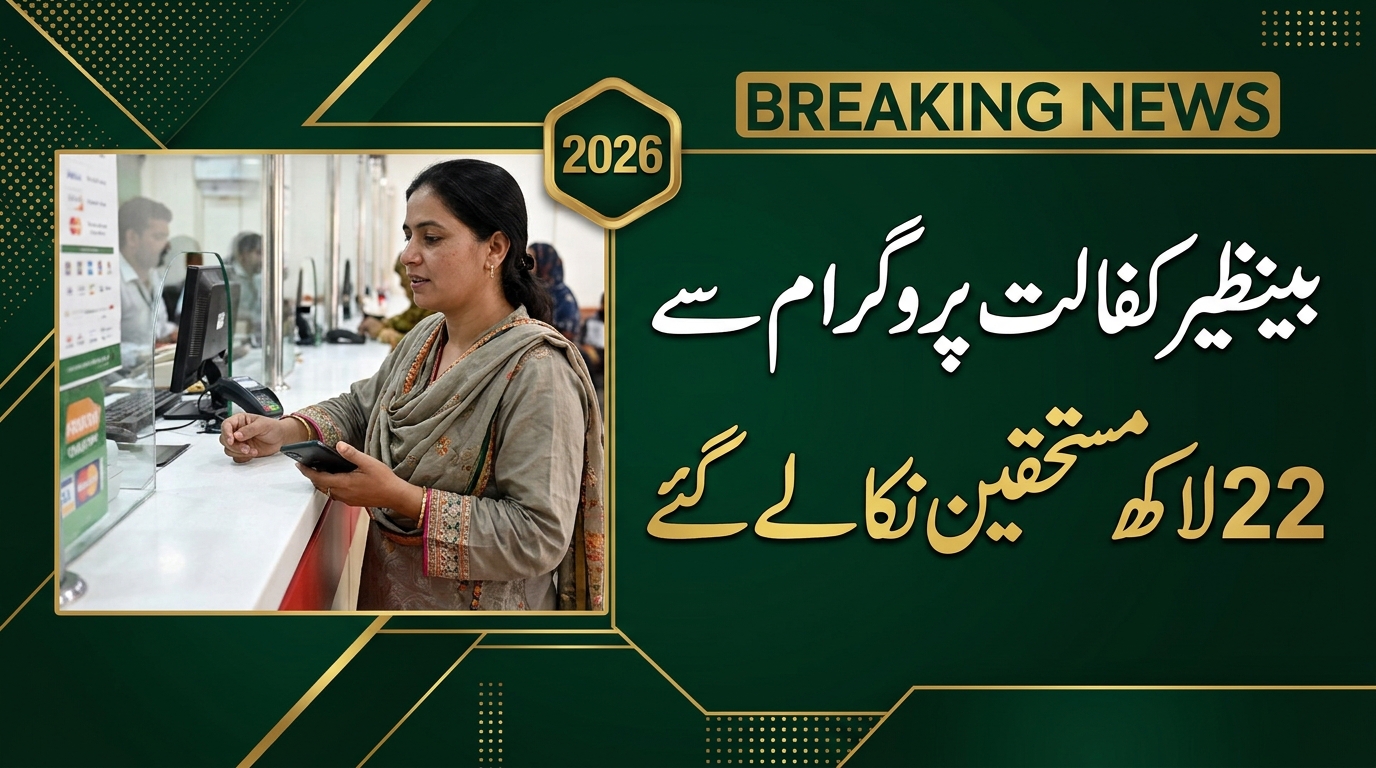
More than 2.25 million people have been struck off the Benazir Income Support Programme in a single financial year, after the government told the National Assembly that its verification drive found them ineligible. The Ministry of Poverty Alleviation and Social Safety said 2,259,404 beneficiaries were removed during 2025–26, while payments to over 800,000 further recipients were suspended. For millions of women who depend on the quarterly Kafaalat payment, the disclosure explains the status changes many are now seeing when they check 8171 — and it sets out exactly what to do if a removal is wrong.
Key Figure
What It Means
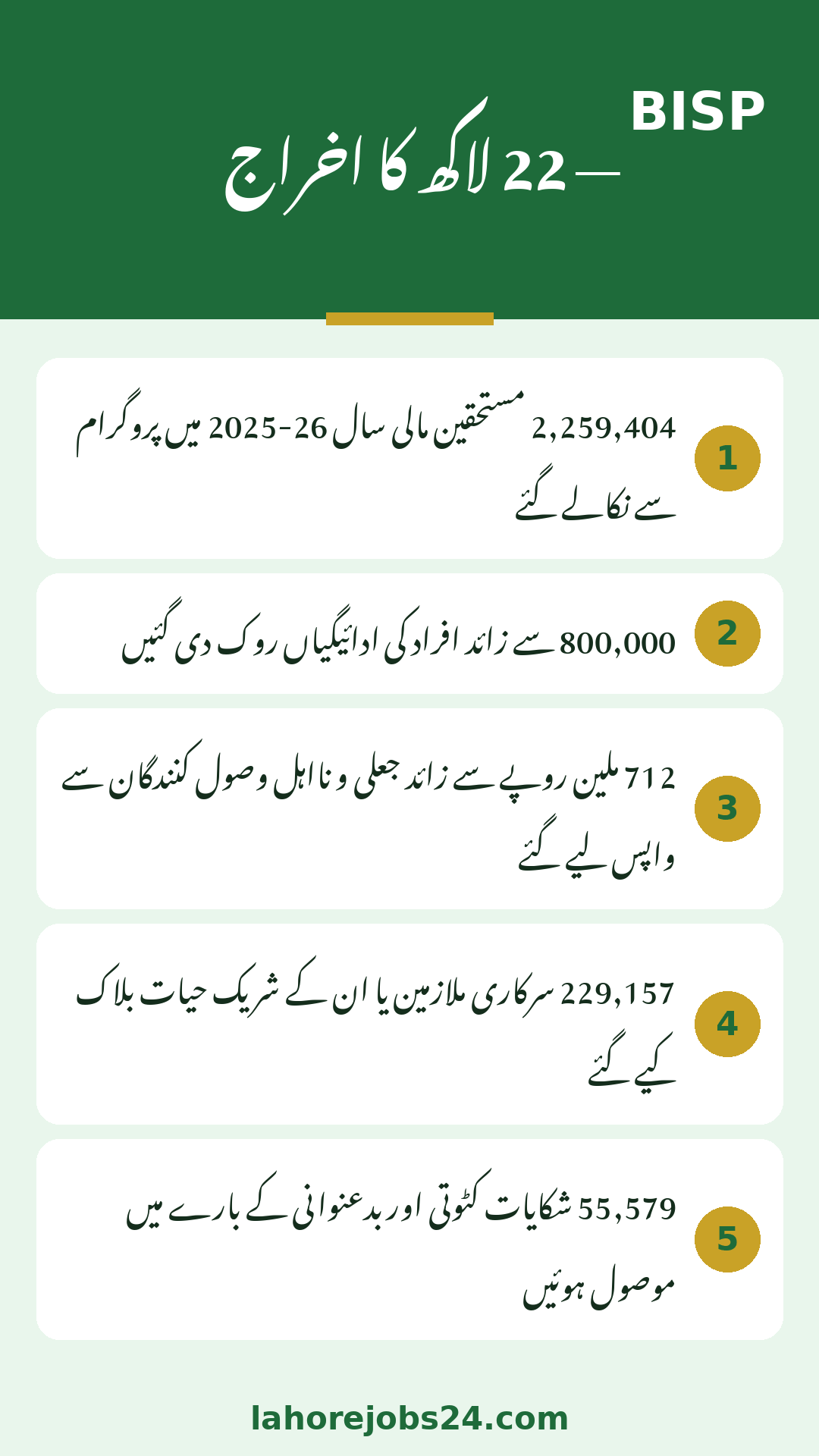
2,259,404 removed
Beneficiaries struck off BISP in FY2025–26 (July 2025 to June 2026)
800,000+ suspended
Further recipients whose payments were stopped after being found ineligible
Rs 712 million recovered
Money taken back from fake and ineligible recipients, mostly through the FIA
55,579 complaints
Complaints in the year about deductions, embezzlement and misappropriation
Rs 14,500 per quarter
Current Kafaalat payment; Rs 18,000 planned from January 2027
Free status check
SMS your CNIC to 8171 or use the official 8171 web portal
The National Assembly Disclosure: What Was Revealed
During question hour, the Ministry of Poverty Alleviation and Social Safety placed before the National Assembly the scale of the clean-up. The 2,259,404 people removed in the year to 30 June 2026 were described by the ministry as fake beneficiaries. On top of that, payments to more than 800,000 others were suspended once they were identified as ineligible. Recoveries from people who had drawn money wrongly passed Rs 712 million, including more than Rs 545 million recovered through the Federal Investigation Agency and more than Rs 21 million from BISP employees themselves.
The removals cover one financial year only: 1 July 2025 to 30 June 2026.
Payments were stopped, not just names removed: over 800,000 recipients had their payments suspended in addition to the removals.
Complaints were large in number: 55,579 complaints about unauthorised deductions, embezzlement and wrongful disbursement.
Action is continuing: the ministry said inquiries are under way and the recoverable amount may rise as profiling continues.
Historical cases also surfaced: a 2019–20 audit had already identified 140,488 government employees and their family members drawing BISP money.
The disclosure came as the government faces pressure to show that social protection money reaches only the households it is meant for, at a time when the programme’s budget stands at Rs 716 billion for 2025–26 and covers around 9.3 million families.
How the Verification Drive Found Ineligible Beneficiaries
The clean-up rests on data, not on door-to-door re-checking alone. Updated employment and pension records were gathered from the Controller General of Accounts, ministries, autonomous bodies and state-owned enterprises, and more than six million records were sent for profiling and further review. Where a record showed a household no longer met the poverty criteria, the beneficiary was blocked or removed.
229,157 government employees or spouses blocked after verification audits matched payroll and pension records.
NADRA matching: CNIC validity and biometric records are cross-checked; an expired or blocked CNIC freezes payment until it is renewed.
Asset checks: a registered vehicle, a large property or frequent international travel can disqualify a household.
Tax records checked: an active income tax filer in the household is an exclusion, even if the filer is not the beneficiary woman herself.
Survey data refreshed: dynamic survey updates can raise a household’s assessed position, for example after a member finds formal work or the family acquires assets.
That is why removals can feel sudden. A woman may have done nothing herself, yet a husband’s government job, a son’s tax filing, a vehicle registration or a pension starting can change the household’s standing in the data.
Understanding the PMT Score of 32
Every BISP decision runs through the Proxy Means Test score. The PMT score is worked out from the NSER household survey — housing standard, land and assets, utility use, household size and employment — and not from income a family declares itself. To keep receiving Kafaalat, a standard household must score 32 or below. A household with a disabled member qualifies up to 37, on production of a disability certificate.
32 or below: the cut-off for standard households, set by the BISP Board.
37 or below: the relaxed cut-off for households with a disabled member.
A rising score ends payment: if a new survey puts the household above the cut-off, payments stop even when earlier quarters were paid.
Surveys repeat every three years: households are reassessed regularly, so eligibility is never permanent.
The score itself is not online: the 8171 portal and SMS reply show status, not the number; the exact score is available at a BISP Tehsil Office on presentation of the original CNIC.
For a woman who believes her score is wrong — because survey data is outdated, a member has left, or assets were recorded incorrectly — the remedy is a fresh dynamic survey, not a phone call to an agent.
Removed, Suspended or Blocked: The Difference Matters
Not every stopped payment means the same thing, and the remedy depends on which category a woman falls into. The table below draws the distinction.
Status
What It Means and What to Do
Removed as ineligible
Government job, filer, pension, high PMT score or disqualifying assets in the data — stands unless the facts genuinely change and are re-verified
Payment suspended
Recipient flagged ineligible in the latest round; check status and survey record at the Tehsil Office before assuming permanent removal
Blocked for documents
Expired or blocked CNIC, failed biometrics, or a survey older than three years — usually fixable at NADRA or the Tehsil Office
Under verification
Survey or biometric steps incomplete — complete them and wait for SMS confirmation; missed quarters during processing are not paid back
Still eligible
Valid CNIC, PMT within cut-off, biometrics done, survey current — payments continue on the quarterly cycle
Women in the “blocked” or “under verification” groups should act quickly, because each quarterly cycle that passes while documents are incomplete is a payment lost. Women in the “removed” group should first find out the exact reason from the Tehsil Office rather than guessing.
How Genuinely Eligible Women Can Secure Their Place
There is no shortcut into BISP, and there is no list an agent can add a name to. Places freed by removals go to households that newly qualify through the dynamic survey, in the programme’s normal cycle. A woman who is genuinely poor, owns little or nothing in her household’s name, and scores within the cut-off should focus on three things: a current survey, matching NADRA records, and patience through the quarterly cycle.
Keep the survey current: if three years have passed, or if household facts have changed, complete a fresh dynamic survey.
Match NADRA records: CNIC validity, marital status and biometrics must agree with the survey; widows in particular should update marital status.
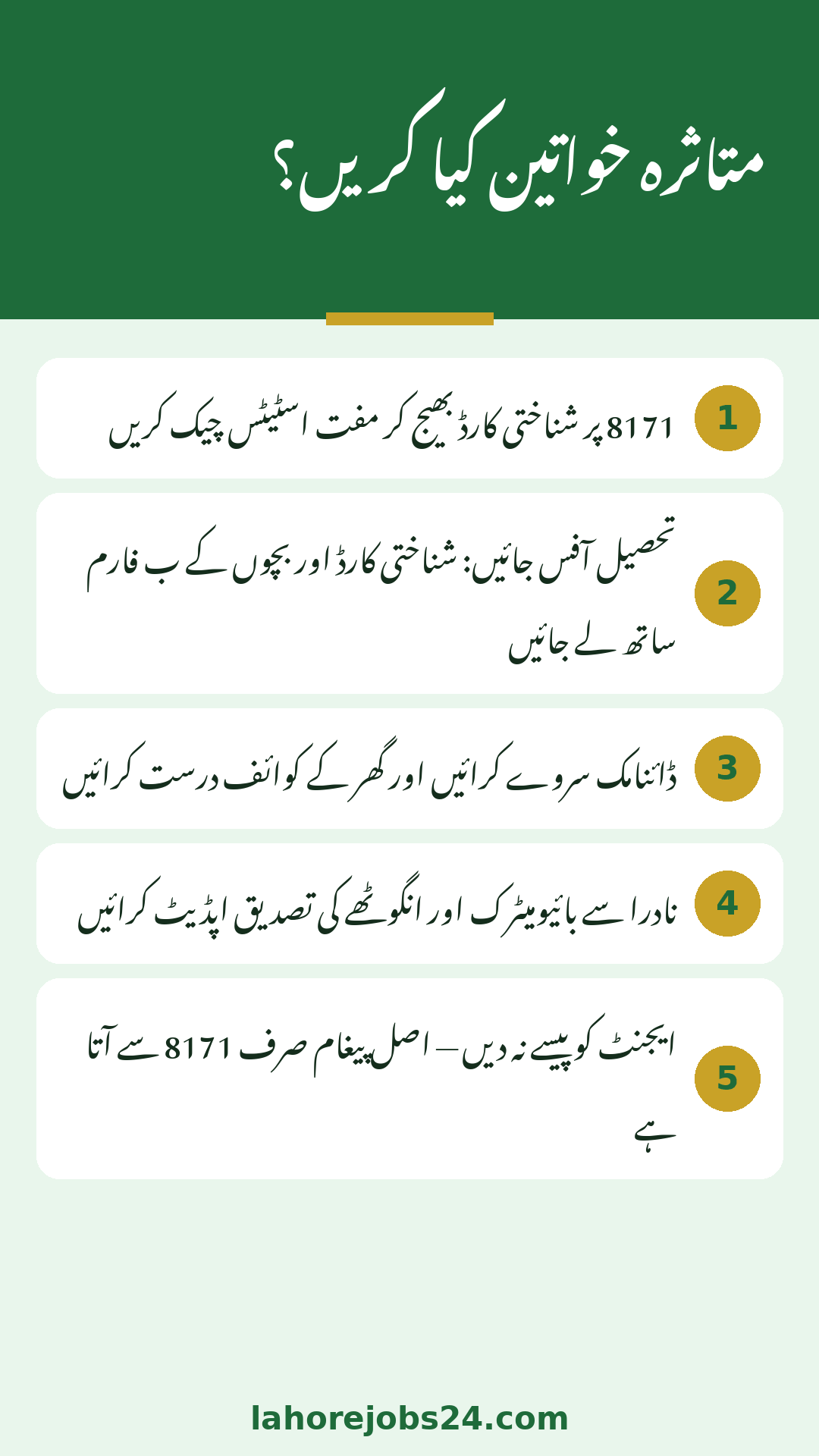
Use only free official channels: status checks, surveys and complaints cost nothing; anyone asking for money is running a scam.
Wait for the SMS: approval arrives by SMS from 8171; no other number speaks for BISP.
Priority for widows and disabled persons: both groups are given preference, with the relaxed 37 cut-off for households with a disabled member.
Forwarded messages claiming that a fixed number of “verification” women have been ordered into the programme should be treated with caution unless they come from BISP itself. The confirmed position is the standing process: newly eligible households enter through survey and verification as ineligible ones leave.
Step-by-Step: Check, Correct and Complain
The following steps use only official routes and cost nothing.
Step 1: Check your status free: send your 13-digit CNIC without dashes by SMS to 8171, or use the official 8171 web portal.
Step 2: Read the reply carefully: “eligible” and “payment released” are different messages, and “payment pending” usually means your district’s phase has not started yet.
Step 3: If a survey or verification is required, go to the nearest BISP Tehsil Office with your original CNIC and your children’s B-Forms.
Step 4: Ask for your NSER data to be verified, and request a new dynamic survey if any detail is wrong or outdated.
Step 5: For biometric failures, update thumb impressions at NADRA, then re-check after two to three weeks.
Step 6: For deductions, fraud or agent demands, call the toll-free helpline 0800-26477 or complain through the 8171 portal or the Tehsil Office Help Desk.
One warning applies across the board: BISP has said its genuine messages come only from 8171. Messages from any other number promising approval, enrolment or payment in exchange for personal details or money are fake.
Conclusion
The National Assembly disclosure puts a number on BISP’s verification drive: 2,259,404 beneficiaries removed in FY2025–26 and payments to more than 800,000 others stopped, with over Rs 712 million recovered. The reasons sit in the data — PMT scores above 32, government employment, filers, pensioners, assets and NADRA mismatches. Women who are genuinely eligible should check their status free on 8171, keep their survey and NADRA records current, and never pay anyone for a place in the programme.
FAQs
How many people did BISP remove in 2025–26?
2,259,404 beneficiaries were removed between 1 July 2025 and 30 June 2026, according to the Ministry of Poverty Alleviation and Social Safety’s report to the National Assembly. Payments to more than 800,000 further recipients were also suspended.
What is the PMT score needed to stay in BISP?
A standard household must score 32 or below. A household with a disabled member qualifies up to 37 with a disability certificate. If a new survey pushes the score above the cut-off, payments stop.
My payment stopped but my situation has not changed. What should I do?
Check your status free by sending your CNIC to 8171, then visit the nearest BISP Tehsil Office with your original CNIC and children’s B-Forms. Ask staff to verify your NSER data and, if anything is wrong or outdated, request a fresh dynamic survey. Update biometrics at NADRA if thumb verification fails.
Does BISP charge any fee for registration or restoration?
No. Registration, surveys, status checks and complaints are all free. Official messages come only from 8171; anyone demanding money for enrolment or restoration is committing fraud and should be reported on the toll-free helpline 0800-26477.
Shahzad Sahil is the editor of lahorejobs24.com, covering government jobs, private jobs, bank jobs, results and education news for Lahore and Punjab, with information verified from official sources.