If you are wondering whether your family qualifies for financial assistance under the Benazir Income Support Programme (BISP), the answer depends on one main thing: your PMT score. The BISP eligibility check 8171 process is the simplest way to find out whether your household is eligible, under verification or not eligible. You do not need to visit an office just to ask this basic question. You can check it from your mobile phone in a few minutes.
Many people in Pakistan hear different things from neighbours, relatives or local agents about who can receive BISP payments. Some say only widows can apply. Others say you need a recommendation or a connection. That is not how the programme works. Eligibility is decided through a survey and a scoring system. If your household meets the conditions, you can qualify. If it does not, the system will show that result clearly.
This guide explains the BISP eligibility check 8171 process in simple words. You will learn what the PMT score means, who can apply, how to check your status, what each result means and what to do if you are not eligible. The information here will help you avoid confusion and protect you from people who charge money for false promises.
BISP Eligibility Check 2026 – Latest Details
Before you check your own status, it helps to understand the basic facts of the programme.
Detail
Information
Programme
Benazir Income Support Programme (BISP)
Eligibility method
PMT score from NSER Dynamic Survey
General eligibility limit
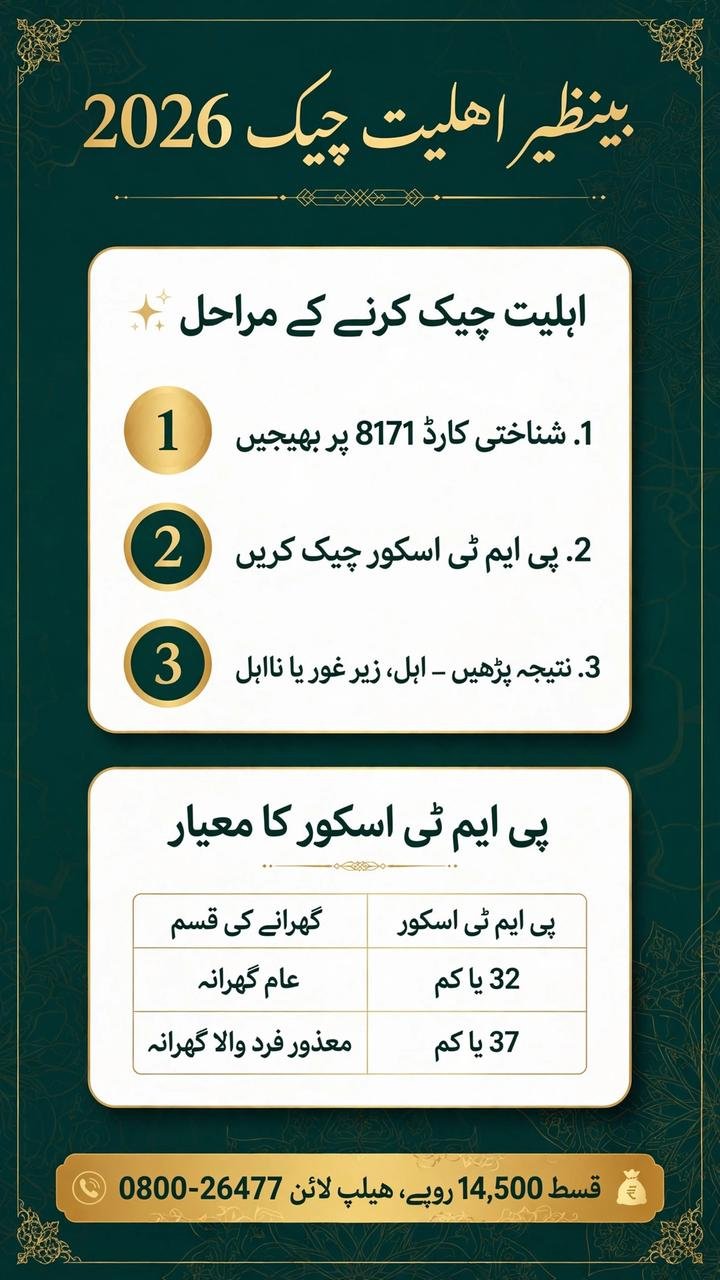
PMT 32 or below
Eligibility limit for households with a disabled member
PMT 37 or below
Eligibility check method
Send CNIC to 8171
Online eligibility portal
8171.bisp.gov.pk
Current Kafaalat installment
Rs 14,500
Current payment cycle
October–December 2026
Planned future installment
Rs 18,000 from January 2027 (planned/proposed)
Registration fee
Free
Official helpline
0800-26477
These details show that eligibility is based on your household information and PMT score, not on personal contacts or payments to agents.
What Is the BISP Eligibility Check?
The BISP eligibility check is the process of finding out whether your household qualifies for BISP financial assistance.
BISP uses the National Socio-Economic Registry (NSER) Dynamic Survey to collect information about households. Based on that information, each household receives a PMT score. PMT stands for Poverty Means Test. The score is a way of measuring the economic condition of a household.
When you complete the BISP eligibility check 8171 process, the system compares your household information with the eligibility rules. It then shows one of the possible results. This helps you understand whether you can receive assistance or whether your record needs attention.
You should understand that eligibility is not decided by a single person at an office. It is decided by the survey information and the PMT score. That is why it is important to provide correct information during the survey and to keep your record updated if your circumstances change.
Understanding the PMT Score
The PMT score is the most important part of BISP eligibility.
It is a number based on the information collected during the NSER Dynamic Survey. The survey asks about your household, income, living conditions and other details. The system uses that information to calculate a score.
A lower PMT score generally reflects a household in a more difficult economic situation. A higher score reflects a household with comparatively better conditions. BISP uses fixed limits to decide eligibility.
General Eligibility Limit: PMT 32 or Below
For most households, the eligibility limit is a PMT score of 32 or below.
If your household score is 32 or below, your household generally qualifies under the programme rules. If your score is above 32, your household generally does not qualify under the general limit.
This limit applies to households without a disabled family member. It is important to understand this distinction because the limit is different for households that include a person with a disability.
Eligibility Limit for Households With a Disabled Member: PMT 37 or Below
Households with a disabled family member have a different eligibility limit.
If your household includes a disabled member, the household may qualify with a PMT score of 37 or below.
This higher limit recognises that families caring for a disabled member may face additional expenses and challenges. The programme therefore allows a higher PMT score for these households.
If you are in this situation, make sure that the disability information is correctly recorded in your survey. Incorrect or missing information can affect your PMT score and your eligibility result.
Household Type
PMT Score Required
General household
32 or below
Household with a disabled family member
37 or below
What Factors Affect Your PMT Score?
Your PMT score is not based on one question. It is calculated from several pieces of information collected during the NSER Dynamic Survey.
Household income: Household income is one of the main factors. Lower income generally leads to a lower PMT score.
Family size: The number of people living in the household is considered.
Housing conditions: The type of house, number of rooms and living conditions are part of the survey information.
Assets: Ownership of property, vehicles or other assets can affect the score.
Education: The education level of household members may be included in the assessment.
Employment status: Whether household members are employed and the type of employment can influence the score.
Disability status: If a family member has a disability, this information is important, especially for the higher PMT limit of 37.
You cannot change your PMT score by requesting it directly. The score changes only when your household information changes and is recorded through the proper survey process.
Who Can Apply for BISP?
BISP is designed for low-income households that need financial support. The programme focuses on women as the main beneficiaries, but eligibility is based on the household survey and PMT score.
The following groups can apply if they meet the eligibility conditions:
Female head of household: A woman who is the head of her household can apply. BISP assistance is usually provided to the female head of the family.
Widows: Widows who are heads of their households can apply. Their household must meet the PMT eligibility limit.
Divorced or deserted women: Women who are divorced or deserted by their husbands can apply if their household qualifies.
Families with a disabled member: Households that include a disabled family member can apply. These households may qualify with a PMT score of 37 or below.
Low-income households: Families with low income can apply. Their eligibility depends on the survey information and PMT score.
It is important to remember that being part of one of these groups does not automatically make you eligible. Your household must still meet the PMT score limit. For example, a widow with a PMT score above the limit would not qualify under the general rules.
How to Check BISP Eligibility Through 8171
The BISP eligibility check 8171 process is simple and does not require any payment. There are two main ways to check your eligibility.
Method 1: Check by SMS
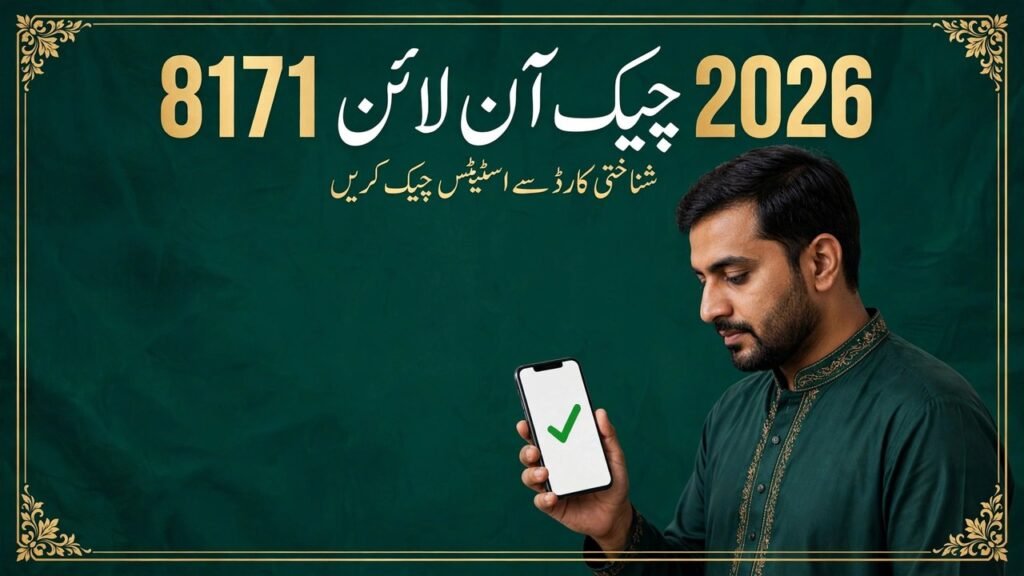
You can check your eligibility by sending your CNIC number to 8171 through SMS.
Follow these steps:
Prepare your CNIC: Keep your 13-digit CNIC number ready.
Open the messaging application: Use the SMS application on your mobile phone.
Enter your CNIC number: Type your CNIC number without dashes.
Send the message: Send your CNIC number to 8171.
Read the response: You will receive a message with information about your eligibility status.
Make sure you send the CNIC number of the woman who is the head of the household or the person whose record is registered with BISP. Sending someone else's CNIC number will not give you the correct information about your own household.
Method 2: Check Online Through the 8171 Portal
You can also check your eligibility through the official online portal.
Enter your CNIC number: Provide the required CNIC information.
Enter the verification code: Complete the verification step shown on the page.
Submit the information: Send the details for checking.
Review your result: The portal will display your eligibility status.
Use only the official portal for this check. Do not use unofficial websites that ask for personal information or promise to change your eligibility result.
What Each BISP Eligibility Result Means
After you complete the BISP eligibility check 8171 process, you will see one of three main results. Each result has a different meaning.
1. Eligible
If your result shows that you are eligible, it means your household meets the programme requirements.
Your PMT score is within the allowed limit, and your record is recognised by the system.
If you are eligible, you should follow the payment information provided through official BISP channels. The current Kafaalat installment for October–December 2026 is Rs 14,500. Payments are released in phases, so your district's payment schedule may affect when you receive the installment.
2. Under Verification
If your result shows that your record is under verification, it means BISP is still reviewing your information.
This can happen when your survey information is being checked or when your record needs further confirmation. It does not necessarily mean that you are not eligible.
In this situation, you should wait for the verification process to complete. You can check your status again after some time. If the status does not change and you need clarification, you can visit the nearest BISP tehsil office with your original CNIC.
3. Not Eligible
If your result shows that you are not eligible, it means your household does not meet the current eligibility conditions.
This usually happens when your PMT score is above the allowed limit. For a general household, this means the score is above 32. For a household with a disabled member, this means the score is above 37.
A "not eligible" result does not always mean your information is wrong. It means that, based on the current survey information, your household does not qualify under the programme rules.
Result
Meaning
What to Do
Eligible
Household meets eligibility conditions
Follow official payment information
Under verification
Record is still being reviewed
Wait and check again; visit tehsil office if needed
If your BISP eligibility check 8171 result shows that you are eligible, you should take a few simple steps to avoid problems later.
Keep your CNIC updated: Make sure your CNIC information is correct and up to date.
Keep your SIM active: Use the SIM registered with your BISP record. An inactive SIM can create problems with payment information.
Wait for your district's payment phase: Payments are released phase-wise, district by district. Your district's turn may not have come yet.
Check your status regularly: Use 8171 to check your payment status when needed.
Visit the BISP office only when needed: You do not need to visit an office for every question. Use the 8171 service first.
What to Do If You Are Not Eligible
If your result shows that you are not eligible, do not panic and do not pay anyone who promises to change the result.
You can take the following steps:
Visit the BISP tehsil office: Go to the nearest BISP tehsil office with your original CNIC.
Ask about your record: Ask the staff about your household record and PMT score information.
Update your information: If your circumstances have changed, ask whether your information can be updated through the proper process. For example, if your income has reduced or your household situation has changed, this information may be relevant.
Do not pay an agent: Registration itself is free. Never pay an agent who claims that they can change your PMT score or make you eligible.
Your eligibility can only change if your household information changes and is recorded correctly through the official survey process. No agent can change your PMT score by taking money from you.
If Your Status Shows "Under Verification"
If your status is under verification, your record is being reviewed.
You should:
Wait for the verification process: Verification can take time. Checking repeatedly will not speed up the process.
Check your status again later: Use 8171 after some time to see if the status has changed.
Visit the tehsil office if needed: If the status remains under verification for a long time, visit the nearest BISP tehsil office with your original CNIC to ask about your record.
Do not pay anyone who promises to complete your verification quickly. Verification is completed through the official process only.
How to Register for the NSER Dynamic Survey
If you have not yet completed the NSER Dynamic Survey, your household may not have a PMT score.
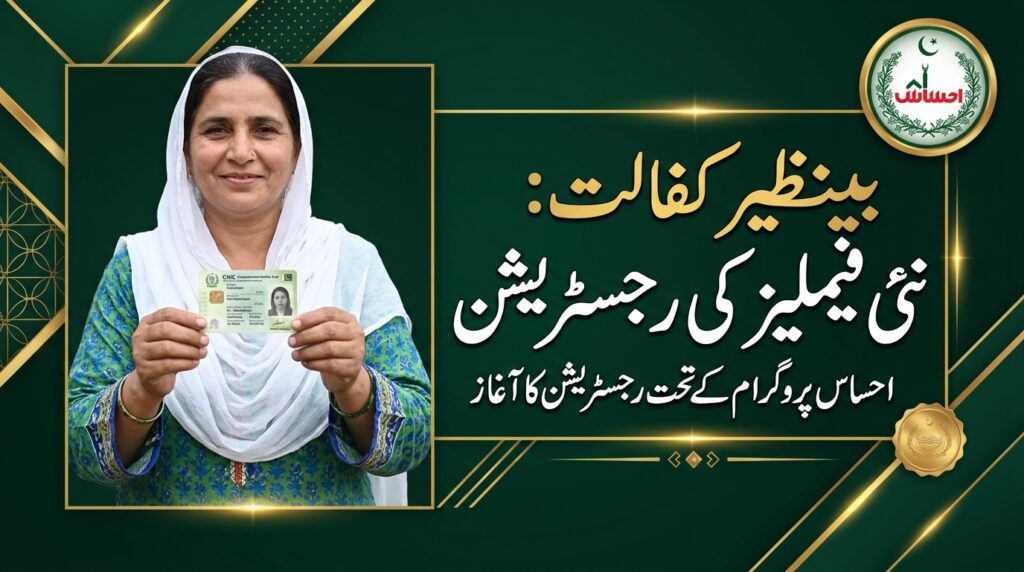
Registration itself is free. You can visit the nearest BISP tehsil office to ask about the survey process. Take your original CNIC with you.
During the survey, provide correct and complete information about your household. Incorrect information can lead to a wrong PMT score and an incorrect eligibility result.
After the survey, your information will be used to calculate your PMT score. You can then check your eligibility through 8171.
Common Mistakes People Make During the Eligibility Check
Many people face problems because of small mistakes. Here are some common errors to avoid:
Sending the wrong CNIC number: Always send the CNIC number of the registered woman or household head.
Using an unofficial website: Only use 8171.bisp.gov.pk for online checks.
Paying an agent: Registration is free. No one should charge you for checking eligibility or changing your result.
Sharing personal information: Do not share your CNIC details with strangers or unofficial agents.
Believing rumours: Do not rely on rumours about eligibility. Check your own status through 8171.
Avoiding these mistakes can save you time, money and unnecessary worry.
Is the BISP Payment Increasing to Rs 18,000?
Some beneficiaries have heard that the BISP Kafaalat payment will increase to Rs 18,000.
The Rs 18,000 amount from January 2027 is planned/proposed. It should not be treated as an amount already being paid.
The current Kafaalat installment for October–December 2026 is Rs 14,500. If you are eligible, your current payment is based on this amount, not on the proposed future amount.
You should check official BISP information for any confirmed changes in the future. Do not rely on unofficial messages or agents for payment information.
Where Can You Get Help?
If you need help with your BISP eligibility check, use official channels only.
8171 SMS service: Send your CNIC to 8171 to check your status.
BISP tehsil office: Visit the nearest BISP tehsil office with your original CNIC for help with your record.
Official helpline: Call 0800-26477 for guidance about BISP services.
Official BISP website: You can also visit the official BISP website at bisp.gov.pk for general information.
Do not contact unofficial numbers or WhatsApp contacts that claim to provide BISP services. These are not official channels and can be used to mislead beneficiaries.
The BISP eligibility check 8171 process is the easiest way to find out whether your household qualifies for BISP assistance. Your eligibility depends on your PMT score from the NSER Dynamic Survey. A general household qualifies with a PMT score of 32 or below, while a household with a disabled family member qualifies with a PMT score of 37 or below.
You can check your status by sending your CNIC to 8171 or visiting the official portal at 8171.bisp.gov.pk. If your result shows that you are eligible, follow the official payment information. If your status is under verification, wait for the process to complete. If you are not eligible, visit the nearest BISP tehsil office with your original CNIC to ask about your record and update your information if your circumstances have changed.
Registration itself is free, and you should never pay an agent to fix your eligibility. By using official channels and understanding your PMT score, you can check your BISP eligibility with confidence and avoid unnecessary problems.
Frequently Asked Questions (FAQs)
1. What is the BISP eligibility check 8171?
The BISP eligibility check 8171 is the process of checking whether your household qualifies for BISP assistance by sending your CNIC to 8171 or visiting the official portal at 8171.bisp.gov.pk.
2. What is the PMT score?
The PMT score, or Poverty Means Test score, is a number calculated from the information collected during the NSER Dynamic Survey. It is used to decide whether a household qualifies for BISP assistance.
3. What PMT score is required for BISP eligibility?
A general household qualifies with a PMT score of 32 or below. A household with a disabled family member qualifies with a PMT score of 37 or below.
4. Who can apply for BISP?
Female heads of households, widows, divorced or deserted women, families with a disabled member and low-income households can apply if they meet the PMT eligibility conditions.
5. How can I check my BISP eligibility?
You can check your eligibility by sending your CNIC number to 8171 through SMS or by visiting the official portal at 8171.bisp.gov.pk.
6. What does 'eligible' mean in the BISP eligibility check?
It means your household meets the programme requirements and your PMT score is within the allowed limit.
7. How can I check whether I qualify for BISP?
You can check by sending your CNIC to 8171 or visiting the official portal at 8171.bisp.gov.pk. Your result will show whether you are eligible, under verification or not eligible.
8. What does 'under verification' mean?
It means BISP is still reviewing your survey information or record. It does not necessarily mean that you are not eligible.
9. What does 'not eligible' mean?
It means your household does not meet the current eligibility conditions, usually because your PMT score is above the allowed limit.
10. What should I do if I am not eligible for BISP?
Visit the nearest BISP tehsil office with your original CNIC to ask about your record and update your information if your circumstances have changed.
11. Can a household with a disabled member qualify with a higher PMT score?
Yes. A household with a disabled family member can qualify with a PMT score of 37 or below.
12. Is BISP registration free?
Yes. Registration itself is free. You should never pay an agent to check your eligibility or change your result.
13. What is the current BISP Kafaalat installment?
The current Kafaalat installment for October–December 2026 is Rs 14,500.
14. Will the BISP payment increase to Rs 18,000?
Rs 18,000 from January 2027 is planned/proposed. It should not be treated as an amount already being paid.
15. Can I check my eligibility without visiting a BISP office?
Yes. You can check your eligibility by sending your CNIC to 8171 or visiting the official portal at 8171.bisp.gov.pk.
16. What is the NSER Dynamic Survey?
The NSER Dynamic Survey is the survey used by BISP to collect household information. The information is used to calculate the PMT score.
17. What should I do if my status is under verification?
Wait for the verification process to complete and check your status again later. If it does not change, visit the nearest BISP tehsil office with your original CNIC.
Shahzad Sahil is the editor of lahorejobs24.com, covering government jobs, private jobs, bank jobs, results and education news for Lahore and Punjab, with information verified from official sources.