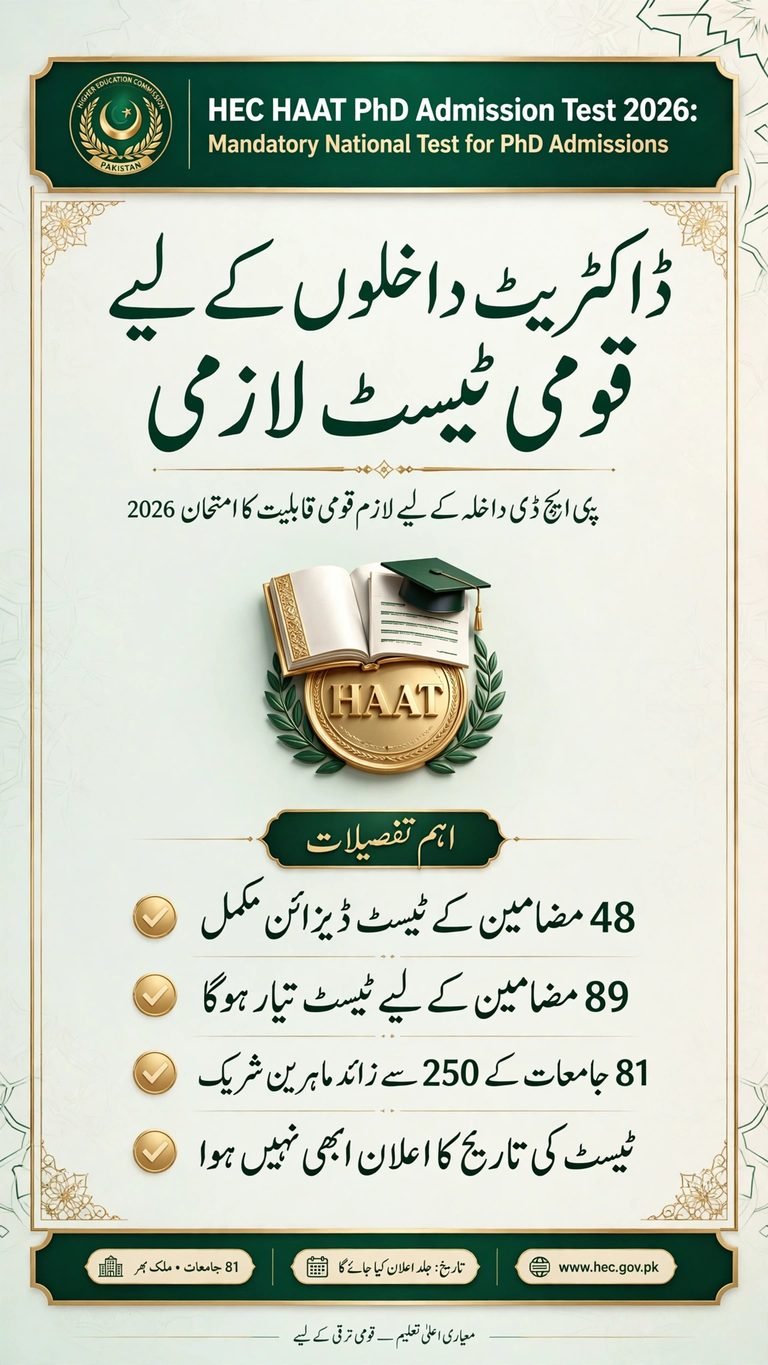
The Higher Education Commission (HEC) is introducing a new national standardised test that will be mandatory for admission to PhD programmes across Pakistan. Known as the Higher Education Aptitude and Achievement Test (HAAT), it is being developed by HEC’s Education Testing Council (ETC) to create a uniform system for evaluating doctoral admission candidates. The HEC HAAT PhD admission test reached a major milestone this month, when the ETC finalised assessment designs for 48 PhD disciplines during the first phase of its HAAT Subject Committee Meeting.
More than 250 academics, subject specialists and university representatives from 81 public and private universities participated in the meeting, which was inaugurated by HEC Chairman Prof Dr Niaz Ahmad Akhtar. The meeting, held on 5 November 2026, marked the culmination of the first phase of HAAT development, a process the ETC began in May 2026. HEC says the new test will be mandatory for PhD admissions across Pakistan, and subject committees have now been established for 89 disciplines.
HEC HAAT PhD Admission Test at a Glance
Detail
HEC HAAT PhD Admission Test
Test name
Higher Education Aptitude and Achievement Test (HAAT)
Developed by
Education Testing Council (ETC), Higher Education Commission
Mandatory for
Admission to PhD programmes across Pakistan
Disciplines finalised
48 PhD disciplines (Phase I)
Total disciplines planned
89 disciplines
Meeting participants
250+ academics and specialists from 81 universities
Development started
May 2026
What Is HAAT and Why Is HEC Introducing It
One national test: HAAT is designed as a single national standardised test for PhD admissions, replacing the patchwork of different university-level tests that candidates currently face.
Uniform evaluation: HEC Chairman Prof Dr Niaz Ahmad Akhtar stressed the need for a transparent, merit-based and uniform assessment system for graduate admissions across the country.
Subject-based design: Unlike a general aptitude test, HAAT assessments are being designed subject by subject, so candidates are tested on the knowledge and research skills of their own discipline.
Built by subject committees: Subject committees of academics and specialists are developing the test designs and Tables of Specifications for each discipline, after reviewing their academic relevance and alignment with graduate-level research requirements.
First-phase milestone: During the first phase of the HAAT Subject Committee Meeting, assessment designs and Tables of Specifications were approved for 48 PhD disciplines.
Wide participation: More than 250 academics, subject specialists and university representatives from 81 public and private universities took part in the meeting, giving the test a genuinely national base.
Six months of work: The ETC began developing HAAT in May 2026, and the 5 November 2026 meeting brought the first six months of that work to the approval stage.
Remaining disciplines to follow: Subject committees have been established for 89 disciplines in total, so the remaining 41 disciplines will be covered as HEC continues developing the framework.
How HAAT Differs from HAT and GAT
HAT is the existing test: The Higher Education Aptitude Test (HAT), also run by the ETC, is the current standardised test for MS, MPhil and PhD admissions, and HEC made GRE/HAT mandatory for graduate admissions from Fall 2026 under a notification issued in May 2026.
HAAT is subject-specific: While HAT tests general aptitude, HAAT is being built as a subject-based assessment, with separate designs for each of the 89 PhD disciplines.
PhD focus: HAAT is specifically a PhD admissions test, whereas HAT covers MS, MPhil and PhD programmes together.
No test dates announced yet: HEC has announced the test and its mandatory status, but it has not yet announced registration dates, test dates, test centres or the syllabus for any discipline.
What PhD Aspirants Should Do Now
Keep preparing for HAT: Until HEC announces HAAT test dates, the existing HAT remains the test that universities accept for graduate admissions, so do not stop your HAT preparation.
Watch for the HEC announcement: HEC will announce the HAAT registration schedule, test dates and discipline-wise syllabus in due course. Check the HEC website and the ETC portal for official updates.
Keep your documents ready: PhD applications need your MS or MPhil degree, transcripts and research proposal, so keep these documents ready while you wait for the HAAT schedule.
hec.gov.pk — HEC announcements, policies and updates
Testing body
Education Testing Council (ETC), HEC — develops and conducts HAAT
ETC portal
etc.hec.gov.pk — candidate portal for HEC tests
Test status
Designs finalised for 48 of 89 disciplines; dates not announced yet
Conclusion
The HEC HAAT PhD admission test is now a concrete reality rather than a plan on paper: assessment designs for 48 PhD disciplines have been finalised, subject committees exist for 89 disciplines, and HEC has confirmed that the test will be mandatory for PhD admissions across Pakistan. For PhD aspirants, the practical message is to keep preparing for the existing HAT while watching for HEC’s announcement of HAAT dates and syllabus. The Higher Education Commission developed the test through its Education Testing Council, which has been working on the assessment designs since May 2026.
FAQs
What is the HEC HAAT test?
HAAT is the Higher Education Aptitude and Achievement Test, developed by HEC’s Education Testing Council. It will be mandatory for PhD admissions across Pakistan.
How many PhD disciplines does HAAT cover?
Assessment designs have been finalised for 48 PhD disciplines in the first phase. Subject committees have been established for 89 disciplines in total, and the remaining disciplines will be covered as development continues.
When will the HAAT test be held?
No test date has been announced yet. HEC has announced the test and its mandatory status, but registration dates, test dates, test centres and the syllabus are still to be announced.
Is HAAT the same as HAT?
No. HAT is the existing general aptitude test for MS, MPhil and PhD admissions. HAAT is a new subject-based test designed specifically for PhD admissions, with separate assessments for each discipline.
Should PhD aspirants stop preparing for HAT?
No. Until HEC announces the HAAT schedule, universities continue to accept HAT for graduate admissions. Aspirants should keep preparing for HAT and strengthen their subject knowledge for HAAT at the same time.
Shahzad Sahil is the editor of lahorejobs24.com, covering government jobs, private jobs, bank jobs, results and education news for Lahore and Punjab, with information verified from official sources.