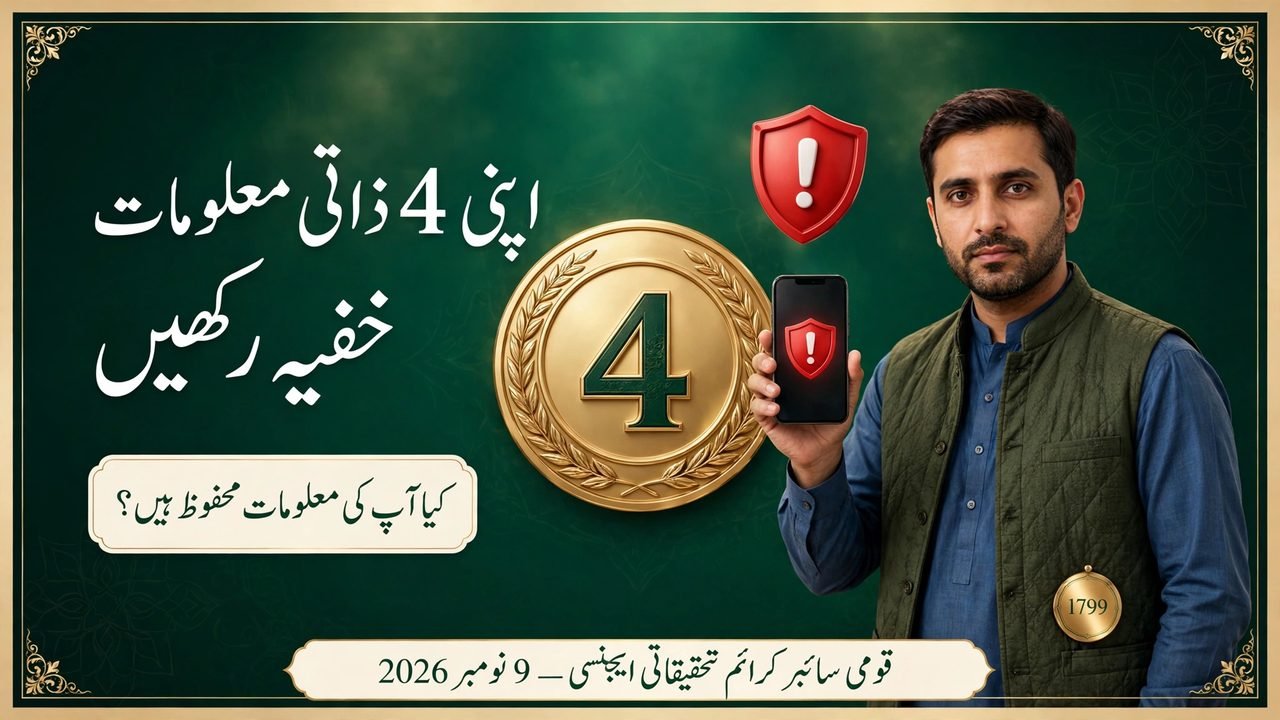
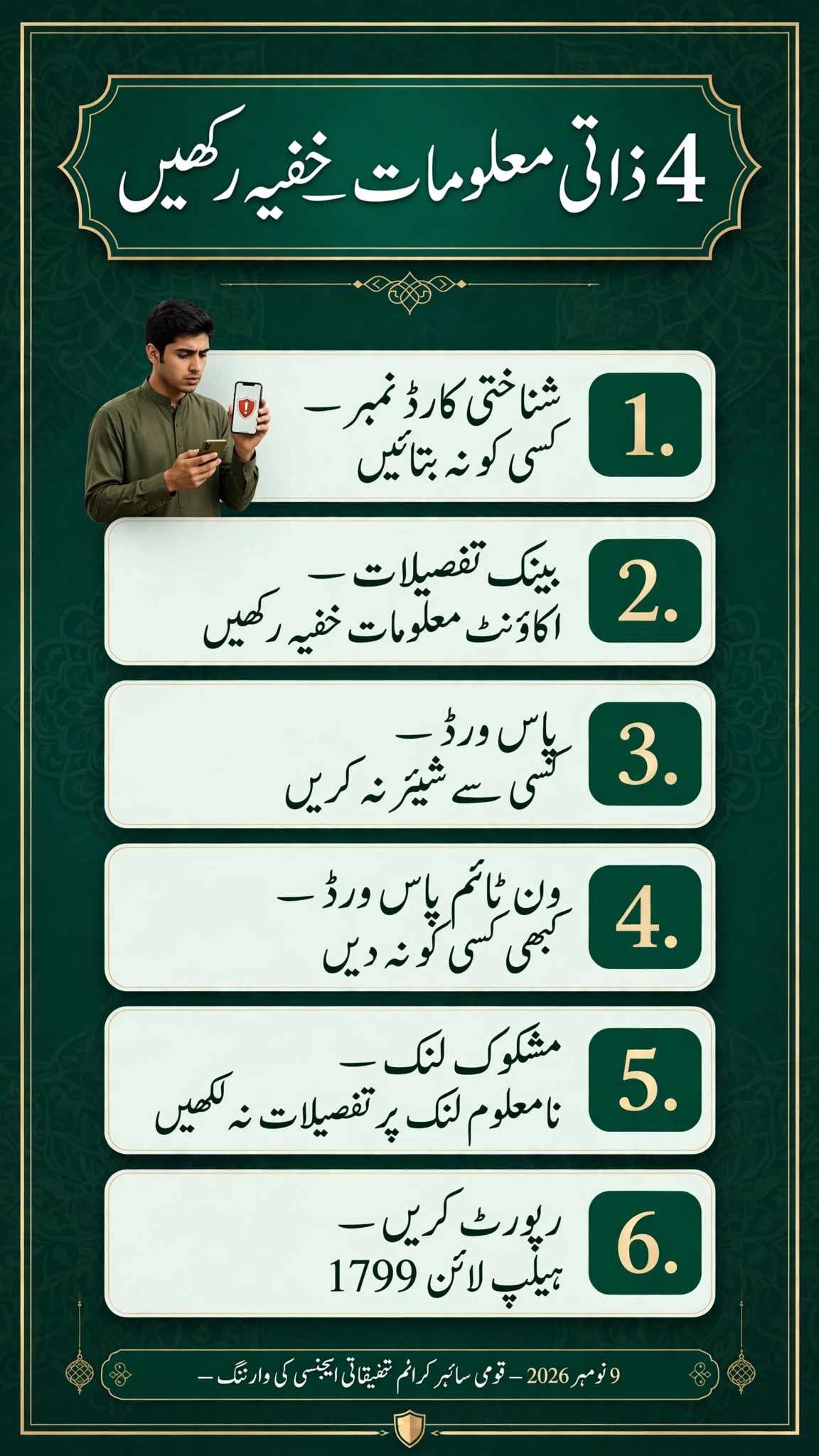
The National Cyber Crime Investigation Agency (NCCIA) has warned Pakistanis to keep four personal details private — their Computerised National Identity Card (CNIC) numbers, bank details and account information, passwords, and one-time passwords (OTPs). In a public awareness advisory issued on 9 November 2026, the agency said careless disclosure can lead to fraud, identity theft and financial losses. Citizens have been urged not to share them with strangers or unverified sources, and never to enter them on suspicious links or unknown websites.
The 4 Personal Details NCCIA Says to Keep Private
Personal Detail
Why It Must Stay Private
CNIC number
Your identity document number — fraudsters can use it for identity theft and to open accounts in your name
Bank details and account information
Account numbers and banking information give criminals direct access to your money
Passwords
Passwords protect bank, email and social media accounts — anyone who has them controls the account
One-time passwords (OTPs)
The final code for a transaction — sharing it lets a fraudster complete a payment in your name
Issued by
National Cyber Crime Investigation Agency (NCCIA), public awareness advisory, 9 November 2026
Where to report
NCCIA helpline 1799 or nearest NCCIA circle office
Source
ProPakistani, 9 November 2026; helpline 1799 corroborated by The Express Tribune
Why Sharing These Details Is Dangerous
The four details work together, and losing even one of them can open the door to fraud. Scammers collect them piece by piece, often through a friendly-sounding call or a message that looks official.
Identity theft: a CNIC number plus other personal information can be used to impersonate a citizen or open accounts in their name.
Bank fraud: bank details let criminals move money out of an account or set up fraudulent transactions.
Account takeover: a password gives a stranger full access to an email, social media or banking account.
Authorised-looking theft: an OTP is the last check before a bank approves a payment, so a fraudster who has it can complete a transfer that looks legitimate.
The advisory gives clear, practical rules for everyday use of phones, messages and the internet.
Keep the four details private: never share your CNIC number, bank details, passwords or OTPs with strangers or unverified online sources.
Share only when necessary, with trusted sources: give sensitive information only when genuinely required and only to a source you trust.
Do not enter details on suspicious links: never type personal information into a link from a message or an unknown website.
Be careful with unknown messages and calls: stay alert when responding to messages, calls and online requests from unknown individuals, even if they claim to represent a bank or another organisation.
Never share OTPs with anyone: no bank or government office ever asks for a one-time password — anyone who asks for it is attempting fraud.
How to Spot a Suspicious Message or Call
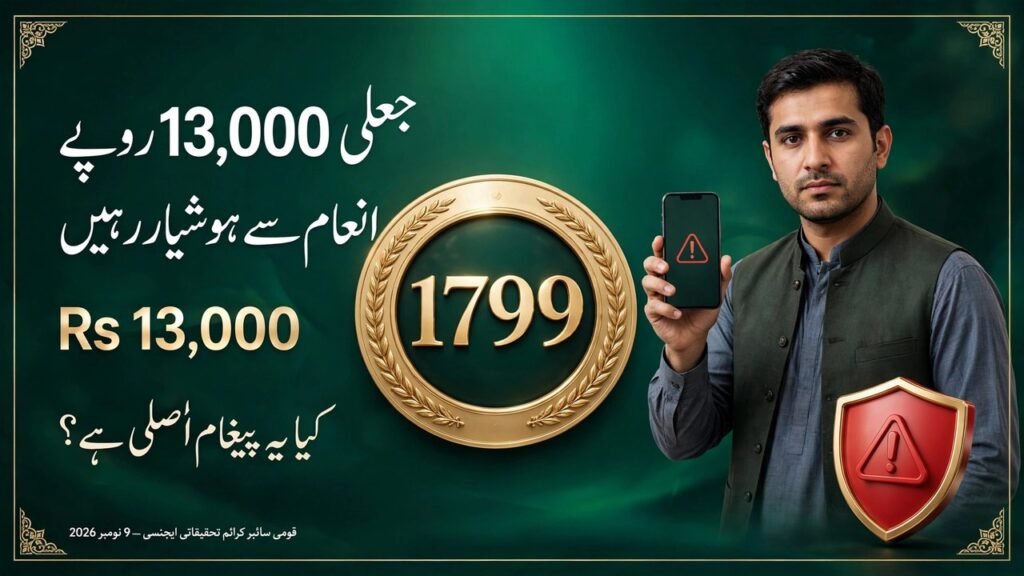
Earlier on 9 November, the NCCIA cautioned citizens against a fake message offering a Rs 13,000 cash reward in the name of Prime Minister Shehbaz Sharif on Iqbal Day. The lesson is the same: a genuine announcement never asks for personal details through a message.
Cash or prize promises: a message offering money or a prize in the name of a government figure is a warning sign — the Rs 13,000 Iqbal Day message was confirmed fake by the NCCIA on the same day.
Pressure to act now: fraudsters create urgency so the victim clicks or replies before thinking; a genuine office gives time and a verifiable channel.
Unknown sender: a message from an unknown number, a shortened link, or a page that asks for personal details before showing anything should not be trusted.
Request for codes: any call or message asking for a password, PIN or OTP is fraudulent, even if the caller claims to be from a bank or a government department.
Check before you act: verify every cash-reward announcement through official government channels first, and report suspicious messages to the NCCIA.
1799 — report cybercrime incidents and suspicious messages
Nearest NCCIA office
Visit your nearest NCCIA circle office to lodge a complaint
Verify announcements
Through official government channels only — never through links in forwarded messages
Conclusion
The NCCIA has warned Pakistanis to keep four personal details private — CNIC numbers, bank details and account information, passwords, and one-time passwords. These details should be shared only when necessary and only with trusted sources, and never entered on suspicious links or unverified platforms. A message or call asking for them, however official it sounds, is an attempt at fraud. Anyone who receives such a message should delete it and report it to the NCCIA on helpline 1799.
FAQs
Which four personal details did the NCCIA warn citizens to keep private? CNIC numbers, bank details and account information, passwords, and one-time passwords (OTPs) — in an advisory issued on 9 November 2026.
Why is sharing an OTP dangerous? An OTP is the final code a bank uses before approving a payment or transfer. If a fraudster has it, they can complete a transaction in your name that looks legitimate.
Should I share my CNIC number or bank details if someone claims to be from my bank? No. No bank asks for passwords, PINs or OTPs by phone, message or link. Share sensitive information only when necessary and only with a trusted source through a verified channel.
What should I do if I receive a suspicious message asking for personal details? Do not click the link, share any details, or forward the message. Delete it and report it to the NCCIA on helpline 1799 or at your nearest NCCIA circle office.
Is the Rs 13,000 Iqbal Day cash reward message real? No. The NCCIA confirmed on 9 November 2026 that the message claiming Prime Minister Shehbaz Sharif is offering Rs 13,000 on Iqbal Day is fake, and its links are designed to steal personal and banking information.
Shahzad Sahil is the editor of lahorejobs24.com, covering government jobs, private jobs, bank jobs, results and education news for Lahore and Punjab, with information verified from official sources.