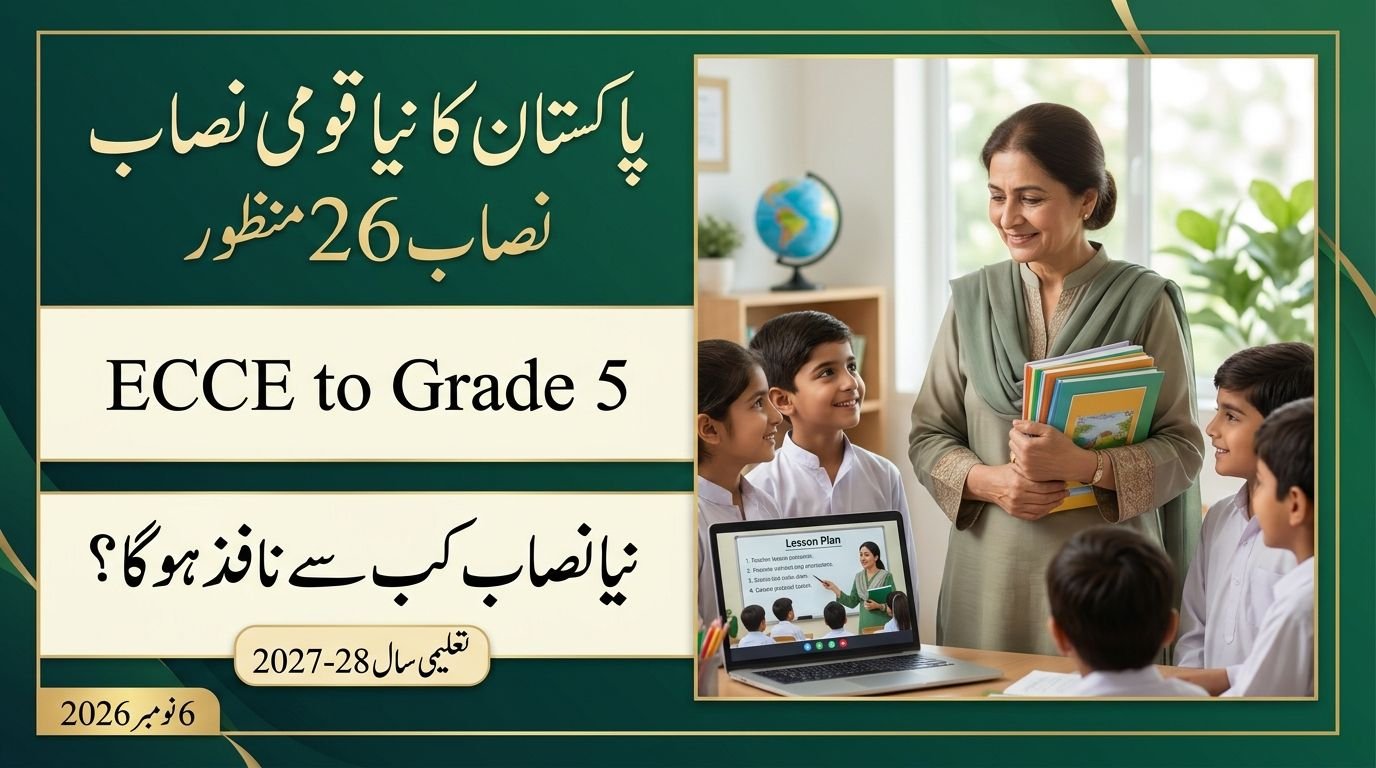
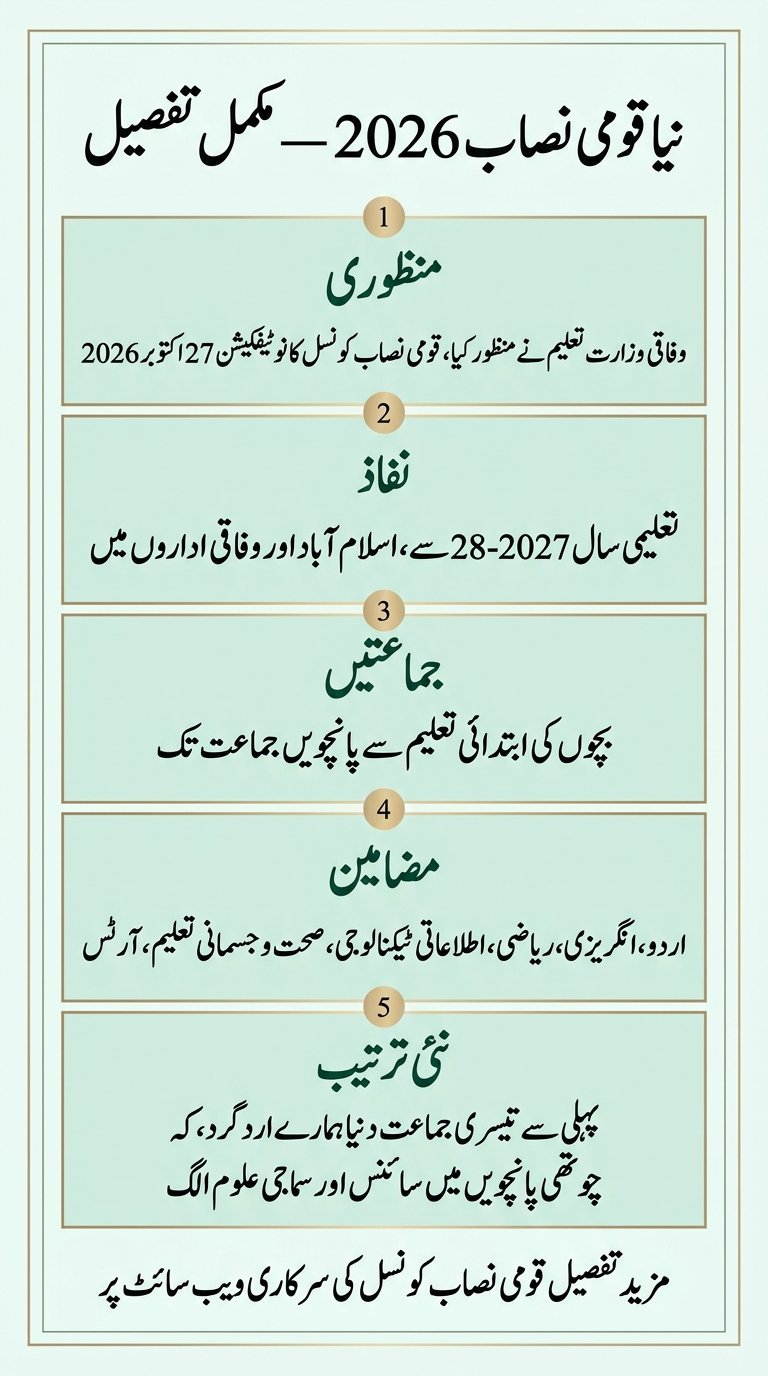
Pakistan has approved a new national curriculum for primary schools, and the change will reach classrooms from the 2027–28 academic year. The New National Curriculum of Pakistan 2026 was approved by the Ministry of Federal Education and Professional Training, and the National Curriculum Council issued the formal notification on 27 October 2026. The revised framework covers children from early childhood education to Grade 5, and it brings information technology into primary classrooms for the first time as a regular subject.
The approval was reported on 30 October 2026, and the framework will apply to public and private schools in Islamabad and to educational institutions operating under federal administration across the country. The Ministry has also sent notifications to all provincial governments, including Punjab, about the approved curriculum. This article explains what the new curriculum contains, which schools it covers, when it starts, and how it differs from the Punjab curriculum that is already in the news.
Point
Detail
Curriculum name
New National Curriculum of Pakistan (NNCP) 2026
Approved by
Ministry of Federal Education and Professional Training
Notification
National Curriculum Council, 27 October 2026
Implementation
Academic year 2027–28
Classes covered
Early childhood education to Grade 5
Where it applies
Islamabad and federally administered institutions
Core subjects
Urdu, English and Mathematics
New subject
Information and Communication Technology, Grades 1 to 5
Curriculum document
Available on the National Curriculum Council website
What Is the New National Curriculum 2026?
The New National Curriculum of Pakistan 2026 is a revised framework for primary education that sets out what children should learn from their earliest school years up to Grade 5. It was developed by the National Curriculum Council, which works under the Ministry of Federal Education and Professional Training, and it was issued through a formal notification that carries the reference F. No. 1-1/2025/NCC(Acad).
Federal framework: The curriculum is a national framework approved at the federal level, and it sets the learning standards for schools that fall under federal administration.
Primary years only: The framework covers early childhood education and primary classes up to Grade 5, so it does not change the syllabus for middle or secondary classes.
Learning outcomes: The approved curriculum includes student learning outcomes and progression grids that teachers can consult when they plan lessons.
Official document: The full curriculum document is being made available on the official website of the National Curriculum Council, where teachers, parents and school administrators can read it in detail.
Notification to provinces: The Ministry has sent formal notifications about the approved curriculum to all provincial governments, including Punjab, so that provinces can consider how it fits with their own education systems.
When Will the New Curriculum Start?
The new curriculum will not start immediately. According to the approved plan, classroom implementation will begin with the 2027–28 academic year, which gives schools, teachers and textbook authorities time to prepare.
Start date: The revised framework will be introduced from the 2027–28 academic year in the schools it covers.
Preparation time: The gap of more than a year allows time for teacher training, textbook preparation and guidance for schools before the first classes begin.
Phased introduction: The framework will initially cover early childhood education and primary classes up to Grade 5, and it will be introduced as a complete package for those years.
No immediate change: Students who are already studying in the current academic year will continue with their existing syllabus, and the new curriculum will apply to the session that starts in 2027–28.
Provincial decisions pending: For schools run by provincial governments, the timing of adoption will depend on the decisions of the relevant provincial authorities, which have been notified but have not yet announced their own implementation schedules.
The new curriculum keeps the traditional core subjects while adding new learning areas that were not part of the primary syllabus before. Urdu, English and Mathematics remain the main subjects, and they are joined by technology, health, physical education and creative subjects.
Urdu: Urdu remains a core subject, and it will continue to build language and communication skills in the early years.
English: English also remains a core subject, with the focus on English language development from the first years of school.
Mathematics: Mathematics stays at the centre of the primary curriculum, covering basic mathematical concepts and skills.
Information technology: Information and Communication Technology becomes a subject for students from Grade 1 to Grade 5, introducing basic digital and technology education at the primary level.
Health and physical education: Health and physical education is included so that children learn about physical activity and health awareness alongside their academic subjects.
Arts and crafts: Arts and crafts are part of the framework to encourage creativity and practical activities in young children.
What Changes for Grades 1 to 3 and Grades 4 to 5?
The new curriculum changes how science and social studies are taught in the primary years. Younger children will study a combined subject, while older primary students will take the two subjects separately.
Grades 1 to 3: Students in Grades 1 to 3 will study a combined subject called “The World Around Us,” which introduces them to their surroundings, nature and society in one learning area.
Grades 4 and 5: Students in Grades 4 and 5 will study Science and Social Studies as separate subjects, with each subject given its own place in the timetable.
Gradual transition: The arrangement creates a gradual move from combined learning in the early years to more structured subject teaching in the upper primary years.
Age-appropriate learning: The combined subject for younger children matches their age and learning level, while the separate subjects for older children prepare them for the subject-based teaching of middle school.
Technology from Grade 1: Information technology runs through all five grades, so children meet basic digital concepts from their first year of school rather than waiting until later classes.
Holistic early learning, play-based activities, language and number readiness
Grades 1 to 3
Urdu, English, Mathematics, ICT, Health and Physical Education, Arts and Crafts, The World Around Us
Grades 4 and 5
Urdu, English, Mathematics, ICT, Health and Physical Education, Arts and Crafts, Science, Social Studies
Which Schools Will Follow the New Curriculum?
The new curriculum applies directly to schools in Islamabad and to educational institutions that operate under federal administration in different parts of the country. Both public and private schools in those areas are covered by the announced framework.
Islamabad schools: Public and private schools in Islamabad will follow the new curriculum from the 2027–28 academic year.
Federal institutions: Educational institutions working under federal administration across the country are also covered, wherever they are located.
Provinces notified: The Ministry has sent notifications to all provincial governments, including Punjab, so provinces are aware of the approved framework and its contents.
Provincial adoption not confirmed: The announced implementation scope should not be confused with a confirmed province-wide schedule. Whether a province adopts the national curriculum for its own schools, and when, will depend on the relevant provincial authorities.
Parents should check locally: Parents in provincial areas should follow announcements from their own provincial education department to learn whether their children’s schools will switch to the new curriculum and when.
How the New Curriculum Differs from Punjab’s Curriculum
The national curriculum should not be confused with the Punjab curriculum that has also been in the news. The two are separate frameworks with different authorities and different coverage, although both cover the same early grades.
Different authority: The national curriculum is approved by the federal Ministry of Education and issued by the National Curriculum Council, while the Punjab curriculum is a provincial framework for Punjab’s own schools.
Different coverage: The national curriculum applies to Islamabad and federal institutions, while the Punjab curriculum applies to schools in Punjab.
Punjab’s own changes: Punjab has introduced its own digital curriculum for primary classes, with lighter textbooks and QR video lessons, and it has also announced a smart syllabus for Classes 9 to 12 through the provincial education authority.
Both aim at modernisation: Both frameworks introduce technology into early learning, but they do so through different routes and under different authorities.
Check the right source: Parents and teachers should check whether their school follows the federal framework or the provincial one, because the syllabus, textbooks and timetable will depend on that answer.
The approval of the New National Curriculum of Pakistan 2026 is an important step for primary education in the country. From the 2027–28 academic year, children from early childhood education to Grade 5 in Islamabad and federal institutions will study a revised curriculum that keeps Urdu, English and Mathematics at its centre while adding information technology, health education and creative subjects. Younger children will learn through a combined subject called “The World Around Us,” and older primary students will take Science and Social Studies separately. Provinces, including Punjab, have been notified, but their own adoption decisions are still to come. Parents and teachers should read the official curriculum document on the National Curriculum Council website and follow announcements from their own education departments for the details that affect their schools.
FAQs
When will the New National Curriculum 2026 start?: The new curriculum will be implemented from the 2027–28 academic year in the schools it covers.
Which classes does the new curriculum cover?: It covers early childhood education to Grade 5, and it does not change the syllabus for middle or secondary classes.
Which schools will follow the new curriculum?: Public and private schools in Islamabad and educational institutions under federal administration will follow it. Provinces have been notified but have not yet announced their own adoption schedules.
What new subject has been added for primary students?: Information and Communication Technology has been added as a subject for students from Grade 1 to Grade 5.
Where can the official curriculum be read?: The approved curriculum will be available on the official website of the National Curriculum Council.
Shahzad Sahil is the editor of lahorejobs24.com, covering government jobs, private jobs, bank jobs, results and education news for Lahore and Punjab, with information verified from official sources.