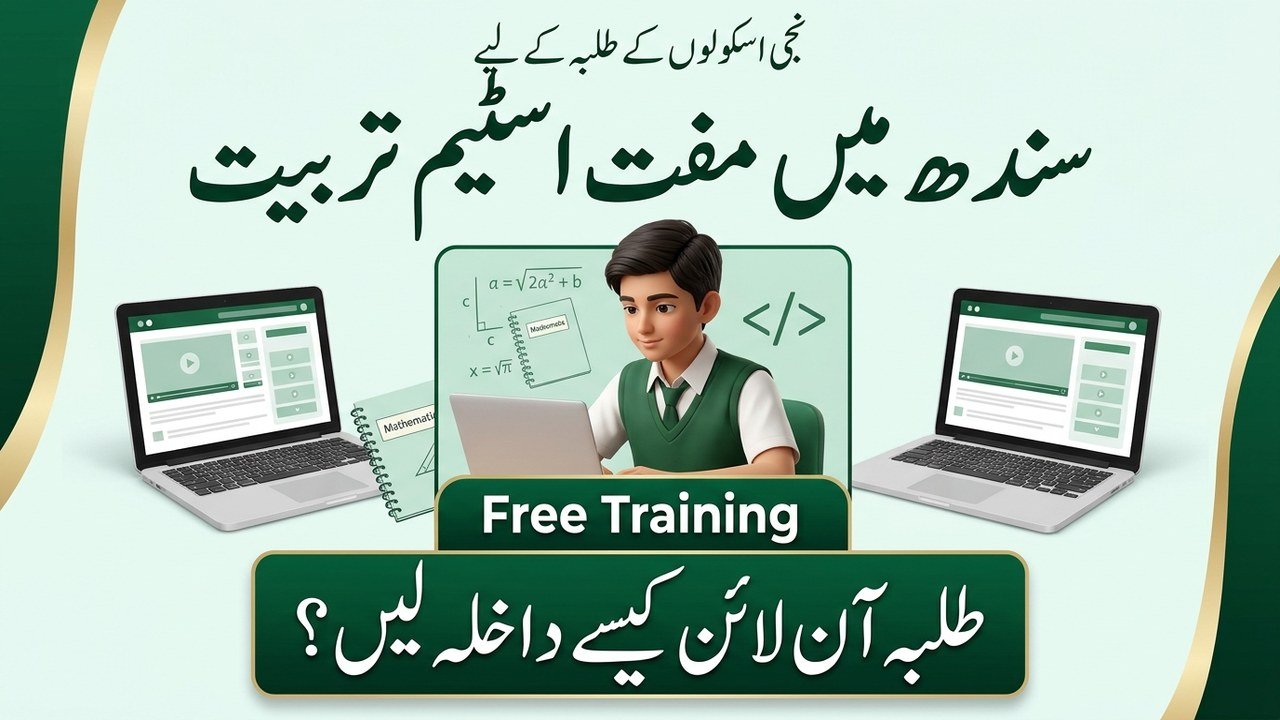
The Sindh government has expanded its free STEM training programme to private schools across the province. Under the Sindh free STEM training expansion, private schools can now enrol talented students in the Virtual STEM School, where they receive free online training in mathematics, computer programming and English. The move widens a programme that was earlier available mainly through government institutions, and it gives private school students the same chance to build academic and technical skills.
The Directorate of Inspection and Registration of Private Institutions Sindh has issued a circular to all regional offices, including Karachi, asking private school administrations and principals to register eligible students. The expansion was reported in early November 2026, and schools have been asked to identify talented students and complete enrolment through the Sundar STEM platform. There is no fee for the training, and students do not need to travel to a campus, because the learning is delivered entirely online.
Point
Detail
Programme
Sundar STEM Initiative — Virtual STEM School
Announced by
Sindh government, School Education Department
Training fee
Free
Training method
Online, through the Virtual STEM School
Subjects
Mathematics, computer programming, English
Who can join
Talented students of private schools in Sindh
Circular issued by
Directorate of Inspection and Registration of Private Institutions Sindh
Focal person
Director of School Education (Secondary), Hyderabad
The Sundar STEM Initiative is a free online learning programme built around the Virtual STEM School. Its name comes from the Sundar STEM School, and the programme focuses on science, technology, engineering and mathematics — the four areas grouped under the short name STEM. Students learn through live online classes and course material, so a student in any district can take part without travelling to a training centre.
The programme is not new. Earlier coverage reported that the Sundar STEM School, in collaboration with the Virtual University, offered free online courses in English, mathematics and computer science, with thousands of students applying from across Pakistan. In one reported round in 2024, 5,000 students were shortlisted and 335 were selected nationwide, including 25 students from Punjab Education Foundation schools. Selected students were reported to receive laptops and internet access to complete the course, which was described as running for three years. That background explains why the Sindh expansion is significant: the same model is now being opened to private school students across an entire province.
Free learning: the training is offered without any tuition fee for enrolled students.
Online delivery: classes and material are provided through the Virtual STEM School platform.
Three subjects: mathematics, computer programming and English language skills.
Skill focus: problem-solving, logical thinking, digital knowledge and communication.
Province-wide reach: the expansion covers private schools across Sindh, not one city only.
What the Expansion Changes for Private Schools
Before this expansion, the programme reached students mainly through government institutions. The new circular changes that by inviting private schools into the same system. The Directorate of Inspection and Registration of Private Institutions Sindh sent the circular to all its regional offices, including Karachi, and asked them to encourage private schools to enrol eligible students. School administrators and principals are now the first step in the process: they identify talented students in their schools and help them register.
For a private school, the practical meaning is simple. A school does not need to build a computer lab or hire new teachers for this programme, because the teaching is delivered online by the Virtual STEM School. What the school must do is select the right students, share the registration instructions with parents, and complete enrolment through the designated platform. The circular asks schools to follow the instructions issued by the education authorities, and to confirm the latest guidance through official channels before submitting student details.
Who is invited: private schools operating across Sindh, through their administrators and principals.
Who selects students: the school itself identifies talented and interested students.
Where training happens: online, so no campus visit is needed for the classes.
What it costs the school: nothing is charged for the training itself.
What to watch: no registration deadline has been announced, so schools should follow official updates.
The programme concentrates on three learning areas. The choice is deliberate: mathematics builds reasoning, programming builds digital skills, and English builds communication. Together, they support a student’s regular schoolwork and prepare them for further study and future careers.
Mathematics
Students learn to solve mathematical problems and improve their logical thinking. The training is pitched at a level above routine textbook exercises, with an emphasis on reasoning and problem-solving. Coverage of the programme describes the mathematics content as Olympiad-standard, which means it is designed to stretch strong students rather than repeat what they already study in class. The Hyderabad region’s performance at the National Mathematics Contest in Lahore is presented as evidence that this approach produces results.
Computer Programming
The programme introduces students to computer programming and helps them develop basic technical knowledge. Coverage reports that the programming teaching covers Python and C++, two widely used languages, and focuses on computational concepts rather than memorising definitions. For many school students, this is their first structured introduction to coding, and the online format lets them practise alongside their regular studies.
English Language
Students receive English language training to improve their communication and language skills. The focus is on understanding and using English clearly, which supports every other subject, because textbooks, examinations and online learning material are often in English. Strong English also helps students who later apply for scholarships, competitions and higher education.
Hyderabad Region Results So Far
The circular points to results from the first phase of the programme, and those results come from the Hyderabad region. Talented students from nine districts of the Hyderabad region have already enrolled on the Sundar STEM platform. That enrolment happened before the province-wide expansion to private schools, which means Hyderabad’s experience is the model other regions are now expected to follow.
Students from Hyderabad also delivered an impressive performance at the National Mathematics Contest held in Lahore. Their achievement is the clearest public evidence so far that the training improves mathematical and analytical ability. It also explains why the education department is confident about expanding the programme: the first phase produced measurable results, not just enrolment numbers. The question now is whether the same results can be repeated in Karachi and the other regions of Sindh as private schools join.
Nine districts: talented students from nine districts of Hyderabad region are already enrolled.
Contest result: Hyderabad students performed well at the National Mathematics Contest in Lahore.
What it proves: the training model has already worked in one region before the expansion.
Next test: whether Karachi and other regions can match Hyderabad’s results.
Who Can Enrol and How to Register Online
Enrolment runs through the school, not through an open public form. Private school administrators and principals identify talented students and register them on the Sundar STEM platform. Parents should therefore contact their child’s school first, rather than trying to register independently, because the school is responsible for nominating its students.
Coverage of the programme reports that the enrolment focus is on high-performing students in Grades 5, 6 and 7 with strong mathematical aptitude, and that school heads complete an institutional nomination form with verified academic details. That grade detail comes from programme coverage rather than from the circular itself, so schools should confirm the exact eligibility with the focal person or the education authorities before nominating students. The official portal for the Virtual STEM School is virtual.sundarstem.edu.pk, and schools should use only that portal and the official instructions for registration.
Review the Directorate’s circular and instructions
2. Identify students
Principal and teachers
Select talented students, reported focus Grades 5 to 7
3. Prepare details
School office
Keep academic records and contact details ready
4. Enrol online
School administration
Register students through the Sundar STEM platform
5. Confirm and follow up
School and parents
Confirm enrolment and follow official updates
What Coverage Reports About the Programme Structure
Some details of the programme come from coverage of the Virtual STEM School rather than from the circular, and they should be read as reported rather than officially confirmed for this expansion. Coverage describes a structured programme spread over three semesters, with live online instruction, course material, and a digitally verifiable completion certificate for students who finish the full programme. It also reports that deserving learners may receive merit-based Chromebooks. These are useful details for parents and schools, but the circular itself does not confirm them, so they should be treated as reported features of the wider Virtual STEM School model.
The same caution applies to the grade range. The circular invites schools to identify talented students without publishing a grade list, while coverage reports a focus on Grades 5, 6 and 7. Parents of students outside that range should not assume their child is excluded; they should ask the school to confirm eligibility with the focal person. What is confirmed is the core offer: free online training in mathematics, programming and English for talented private school students across Sindh.
Reported structure: three semesters of live online instruction, as described in programme coverage.
Reported certificate: a digitally verifiable completion certificate for students who finish.
Reported support: merit-based Chromebooks for deserving learners, as reported in coverage.
Confirmed core: free training in three subjects, open to talented private school students.
Not announced: no registration deadline has been published with the expansion.
Sindh’s Wider Push for Science Learning
The STEM expansion sits inside a wider Sindh effort to promote science learning. A separate initiative, the Sindh STREAM Journey 2026-27, was reported in October 2026, with around 200,000 students from government and private schools expected to take part and a target of 45,000 scientific models, creative projects and innovative ideas. That programme, launched in 2024 under the “Science in Sindh” vision, runs competitions at school, district, divisional and provincial levels, with themes including climate resilience, artificial intelligence, robotics, coding and natural sciences.
The two programmes are different and should not be confused. STREAM is a competition-based journey with festivals and projects, while the Sundar STEM Initiative is a structured online training programme in three subjects. Together, they show that the Sindh School Education Department is pushing science and technology learning through more than one route at the same time. For students, the practical point is that opportunities are increasing, and the schools that act early can place their students in both kinds of programmes.
What Schools and Parents Should Do Now
Schools should act on the circular promptly, even though no deadline has been announced. The first step is to read the circular carefully and nominate students who show real aptitude in mathematics, rather than nominating on the basis of favour or fees. Teachers know which students solve problems quickly and enjoy difficult questions, and those are the students this programme is built for. Parents should ask their child’s school whether it has received the circular and whether it plans to nominate students.
Parents should also remember the basic safety rules that apply to every free government programme. The training is free, so nobody should ask for a fee for registration, enrolment or a place in the programme. Student details should be shared only through the school and the official portal, never with a private agent or through an unknown link. If anyone offers a guaranteed place for money, that is a warning sign, and the matter should be reported to the school or the education authorities. Schools should keep a record of every nomination they submit, so any later question about a student’s enrolment can be answered from their own files.
For schools: read the circular, identify talented students, and enrol them through the official platform.
For parents: ask the school about the programme and confirm your child has been nominated.
For students: keep practising mathematics and basic computer skills while enrolment is processed.
Stay safe: pay no fee to anyone, and use only the official portal and school channels.
Stay updated: follow the education department’s instructions, since no deadline has been announced yet.
Contact and Helpline Details
There is no separate helpline number published with this expansion. Schools and parents should use the official portal and the education department channels below, and confirm any instruction through the focal person before acting on it.
Director of School Education (Secondary), Hyderabad
Circular authority
Directorate of Inspection and Registration of Private Institutions Sindh
First contact
Your child’s school administration or principal
Fee
Free — no registration or training fee
Conclusion
The expansion of free STEM training to Sindh’s private schools is a genuine opportunity for talented students who previously had no route into the Virtual STEM School. The offer is clear: free online training in mathematics, computer programming and English, delivered through a programme that has already produced strong results in the Hyderabad region. Schools now need to do their part by identifying talented students and enrolling them through the official platform, and parents should make sure their child’s school has acted. With no deadline announced yet, the sensible course is to move early, use only official channels, and pay nothing to anyone for a place in the programme.
FAQs
Is the Sindh STEM training really free? Yes. The training through the Virtual STEM School is offered free of charge, and no fee should be paid to anyone for registration or enrolment.
Which subjects will students learn? Mathematics, computer programming and English language skills, delivered online through the Virtual STEM School.
How do private schools register their students? School administrators and principals identify talented students and enrol them through the Sundar STEM platform, following the Directorate’s circular. Parents should contact their child’s school first.
Is there a last date to apply? No registration deadline has been announced with the expansion. Schools should follow the education department’s updates for the latest instructions.
Who is the focal person for the programme? The Director of School Education (Secondary), Hyderabad, has been appointed as the focal person for the initiative.
Shahzad Sahil is the editor of lahorejobs24.com, covering government jobs, private jobs, bank jobs, results and education news for Lahore and Punjab, with information verified from official sources.