If you farm in Punjab and still borrow seed money from commission agents at crushing rates, the Punjab Kisan Card was made for you. Registration for new farmers is open through a simple route: one SMS to start, one visit to the Bank of Punjab for biometric verification, and the card is issued by the bank itself. No middlemen, no registration fee, and no long file moving from desk to desk. This guide explains who can apply, the exact steps, what you receive, and the mistakes that get applications stuck.
Registration fact
Detail
First step
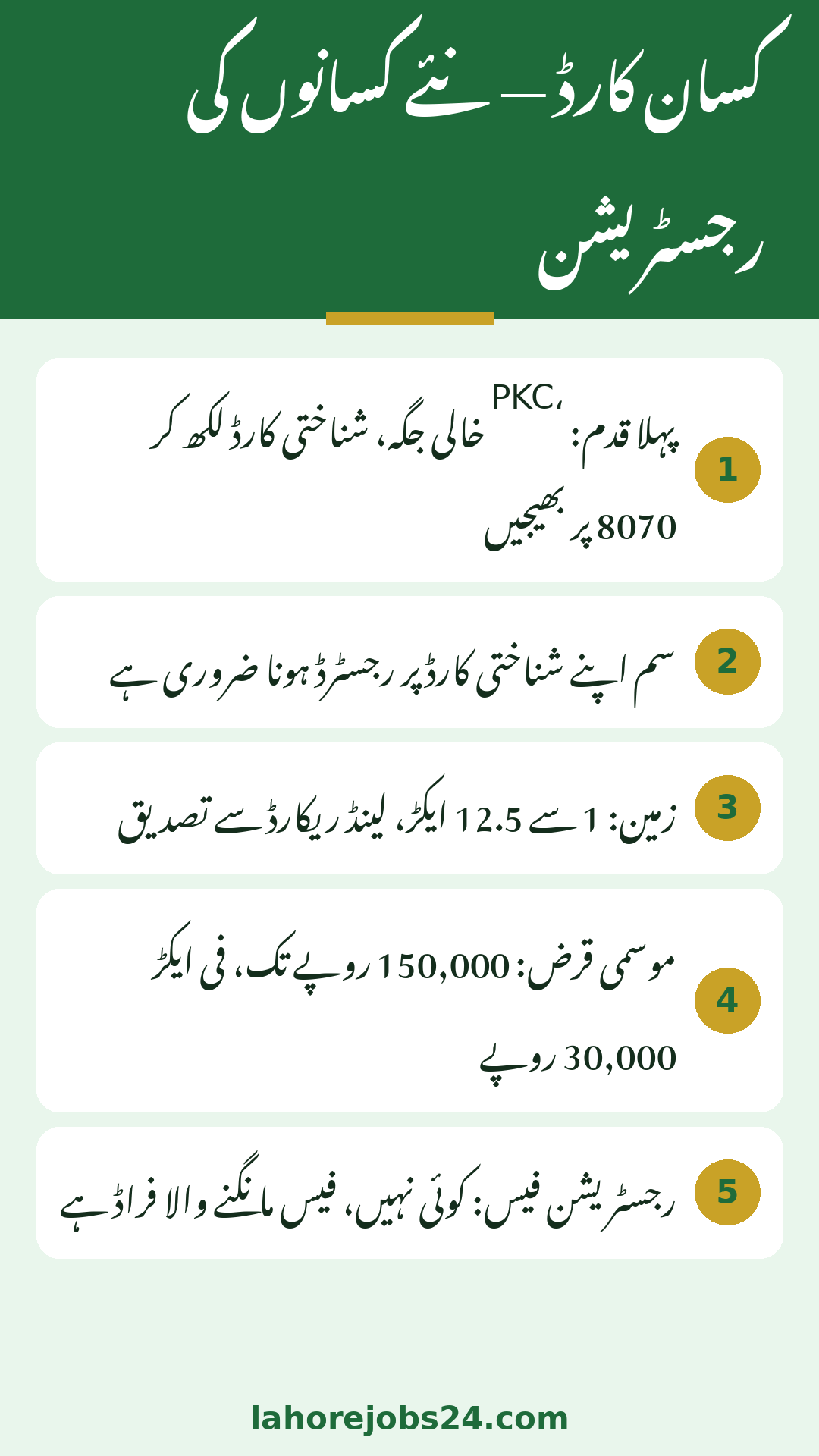
Send PKC, a space, then your 13-digit CNIC without dashes to 8070
Issuing bank
Bank of Punjab, after biometric verification at a branch
Eligible land
1 to 12.5 acres of agricultural land, verified through land records
Seasonal loan
Up to Rs 150,000 per season, at Rs 30,000 per acre, interest-free
Registration fee
None — anyone asking for a fee is running a fraud
Who Can Register for a New Kisan Card
The card is designed for small and medium farmers of Punjab, the ones who carry the province’s food on their shoulders. Registration is not open to everyone with a CNIC, because the loan is tied to real farming land that the system can verify. Before you start, check yourself against the basic conditions below, so your application moves without a hitch.
New farmers: this registration route is for farmers joining the scheme for the first time.
Existing card holders: do not need this process at all; your seasons continue through repayment and reload.
Land link: your application is verified against land records held by the Punjab Land Records Authority.
Land size: farmers owning 1 to 12.5 acres of agricultural land are covered.
Tenant farmers: can also apply where their lease is properly documented and verified.
One card: the facility is issued per eligible farmer through the Bank of Punjab.
If you already hold a Kisan Card, note that the 26 October 2026 bill date for existing card holders has now passed. Paying each bill on time is what reloads your next loan, and recent programme updates report the next loan arriving within 48 hours of repayment. New applicants should not confuse that bill cycle with registration, which is a separate first-time process.
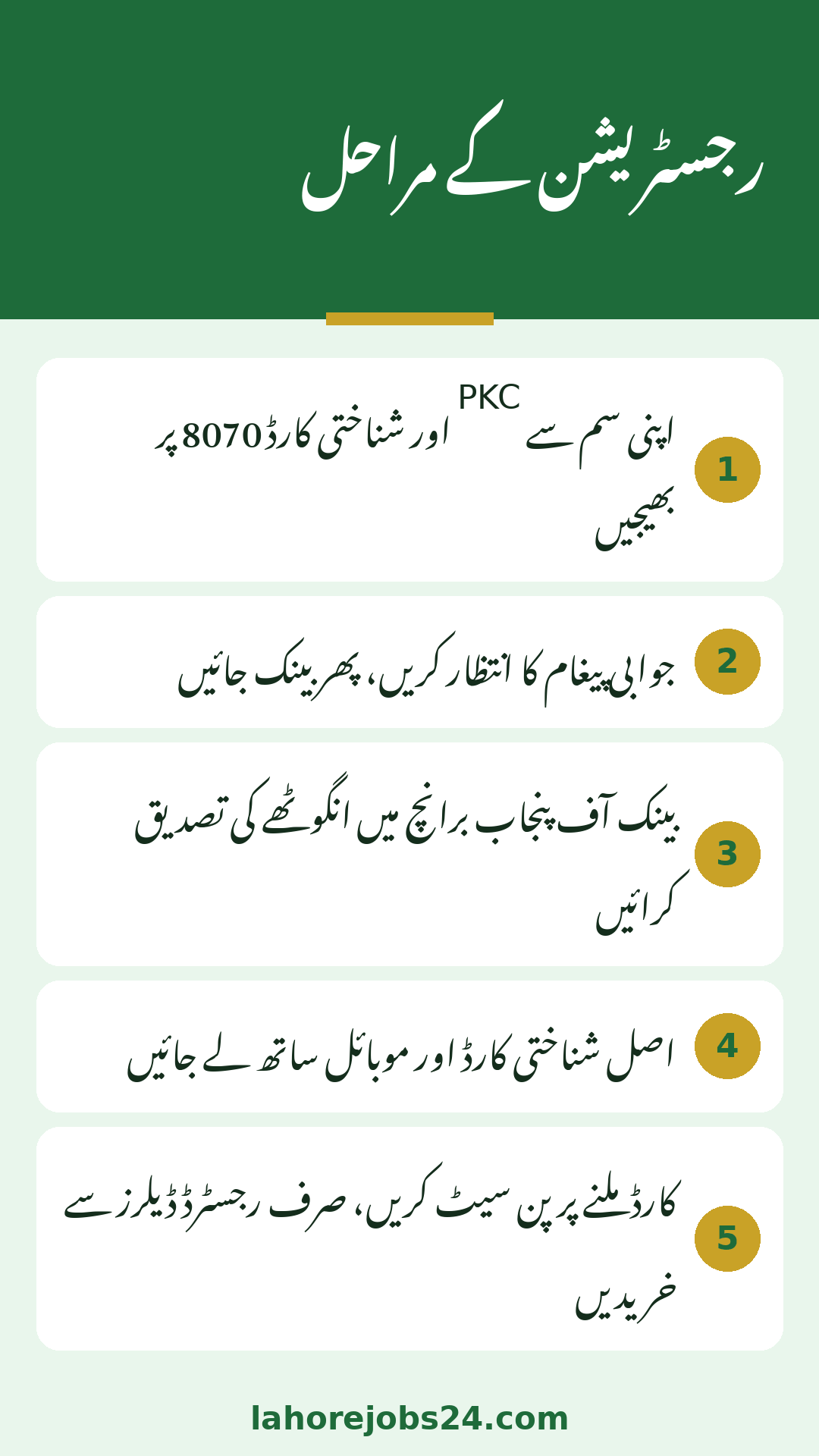
Step 1: Send the PKC SMS to 8070
Registration begins on your own mobile phone. Open your messages, type PKC, add one space, then type your 13-digit CNIC number without dashes, and send the message to 8070. The message must go from a SIM that is registered against your own CNIC, because the system matches your mobile identity with your card application from the very first step.
Format: PKC, a space, then your 13-digit CNIC, for example PKC 3520212345678.
Send to: 8070.
SIM rule: the mobile SIM must be registered on your own CNIC.
Fee: the registration SMS carries no fee.
Keyword warning: the same 8070 shortcode also serves the Punjab Livestock Card, which uses the keyword PLC, so a wrong keyword sends your CNIC to the wrong scheme.
What the SMS does: it opens your registration and confirms status; it is not a balance service, and no genuine balance code exists on 8070.
Wait for the confirmation reply before you take the next step. If no reply arrives, check that the SIM is in your name and that the CNIC digits and the keyword were typed correctly, then resend once.
Step 2: Biometric Verification at Bank of Punjab
After the SMS step, the process moves to the bank that runs the card. Visit a Bank of Punjab branch for biometric verification, where your thumb impression is matched against your CNIC record. This step protects everyone: it proves the farmer himself is applying, and it keeps fraudsters from opening cards in other people’s names.
Carry: your original CNIC.
Carry: your mobile phone with the SIM registered in your name.
Helpful: your land ownership documents, such as a fard, for any record question.
Verification: thumb biometric at the branch, matched with NADRA records.
Land check: your land is verified through the Punjab Land Records Authority system as part of the process.
Record errors: if your land record carries an old error, get it corrected at the land record office first, because the card system will only believe the official record.
Bank staff will guide you through the account and card steps once verification succeeds. Do not hand your CNIC or phone to anyone outside the branch who offers to complete this step for you.
Step 3: Your Card Is Issued by the Bank
Once your SMS registration, land verification and biometric steps are complete, the Bank of Punjab issues your Kisan Card. The card works like a debit card and is accepted at registered agricultural input dealers, where you buy seed, fertiliser and pesticides within your seasonal limit.
Seasonal limit: up to Rs 150,000 per crop season, calculated at Rs 30,000 per acre.
Interest: fully interest-free; you repay only the amount you actually used.
Season length: one crop season, roughly six months, after which repayment reloads the next season.
Where it works: registered dealers only, not every shop in the market.
Alerts: free SMS notifications arrive for transactions on the card.
Activation: set your PIN at the bank or ATM as instructed when you collect the card.
Use the card only for agricultural inputs. Spending outside the approved purpose, or handing the card to another person, can block your next season’s reload. Keep the card in your own possession, check your SMS alerts after every purchase, and report any transaction you do not recognise to the Bank of Punjab branch without delay.
Mistakes That Get Applications Stuck
Most stuck applications fail on one of a handful of avoidable errors. Run through this list before you apply, and again if your application stalls.
Wrong keyword: PLC instead of PKC sends your CNIC to the Livestock Card record.
SIM in another name: a family member’s SIM fails the identity match, even if the CNIC is yours.
Unverified land record: a disputed or outdated fard stops verification until it is corrected.
Existing card holder re-applying: if you already hold a card, registration is not your route; repayment and reload is.
Paying an agent: registration is free, so any fee demand is fraud and should be reported.
Sharing your PIN or OTP: no bank or programme official will ever ask for them.
If your application is rejected, the reply or the branch will usually point to the reason, such as a mismatched land record or SIM ownership issue. Fix that specific problem and apply again, rather than resending the same SMS repeatedly.
Your situation
What to do
New farmer, never applied
Send PKC and CNIC to 8070, then visit Bank of Punjab for biometric verification
Already hold a card
Do not re-register; repay on time and your next loan reloads
Land record has an error
Correct it at the land record office before applying
Tenant farmer
Apply with a properly documented and verified lease
Someone asks for a fee
Refuse and report it — registration is completely free
Punjab Kisan Card registration for new farmers is deliberately simple: one SMS, one bank visit, and one card. Send PKC and your CNIC to 8070 from your own SIM, complete biometric verification at a Bank of Punjab branch, and make sure your land record is clean before you start. The reward is an interest-free seasonal loan of up to Rs 150,000 at Rs 30,000 per acre, usable at registered dealers for the inputs your crop actually needs. Keep the keyword right, keep your SIM in your own name, and never pay anyone for a process the government provides free. You can find programme information through the Punjab Agriculture Department portal at agripunjab.gov.pk.
FAQs
How do I register for the Punjab Kisan Card?
Send PKC, a space, then your 13-digit CNIC without dashes to 8070 from a SIM registered in your own name, then complete biometric verification at a Bank of Punjab branch.
Who can apply for a new Kisan Card?
Farmers in Punjab owning 1 to 12.5 acres of verified agricultural land, including tenant farmers with a properly documented lease.
How much loan does the Kisan Card give?
Up to Rs 150,000 per crop season, calculated at Rs 30,000 per acre, interest-free.
What is the difference between PKC and PLC on 8070?
PKC is the Kisan Card keyword and PLC is the Livestock Card keyword; using the wrong one sends your CNIC to the wrong scheme.
I already have a Kisan Card. Do I register again?
No. Existing holders continue through repayment and reload; paying each bill on time reloads the next season’s loan.
Is there a registration fee?
No. Registration is free, and anyone asking for a fee is committing fraud.
Shahzad Sahil is the editor of lahorejobs24.com, covering government jobs, private jobs, bank jobs, results and education news for Lahore and Punjab, with information verified from official sources.