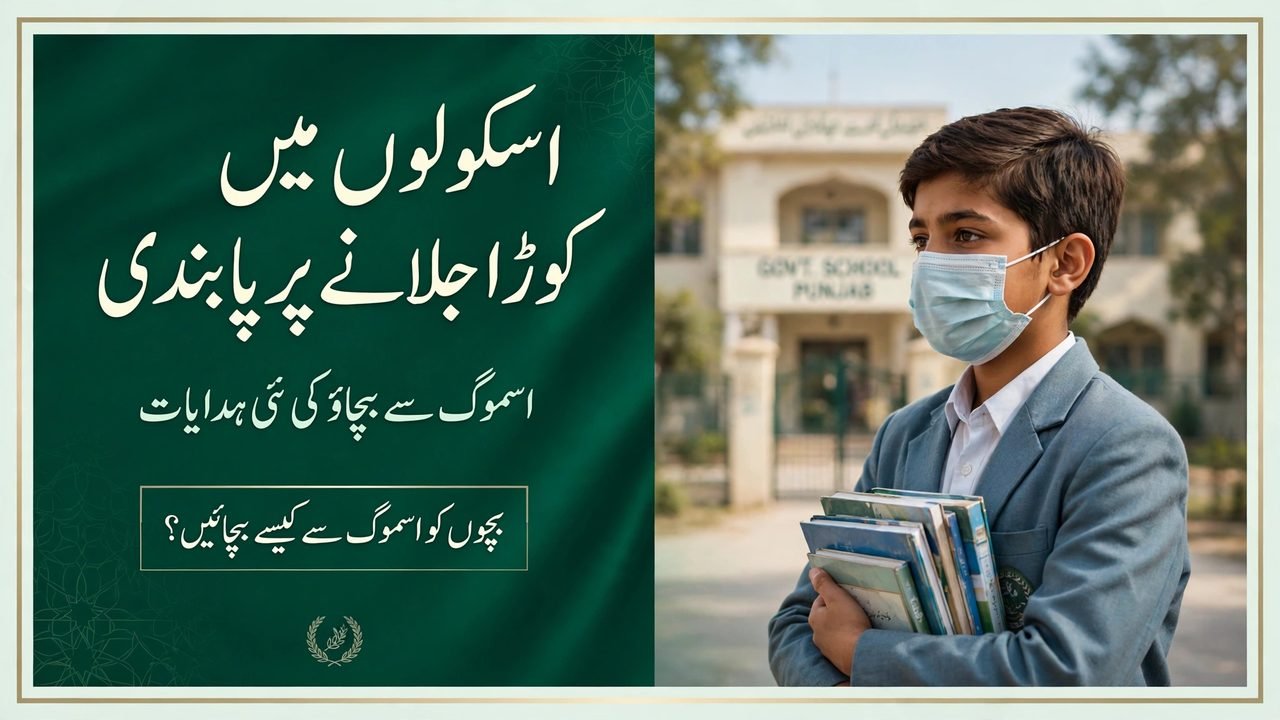
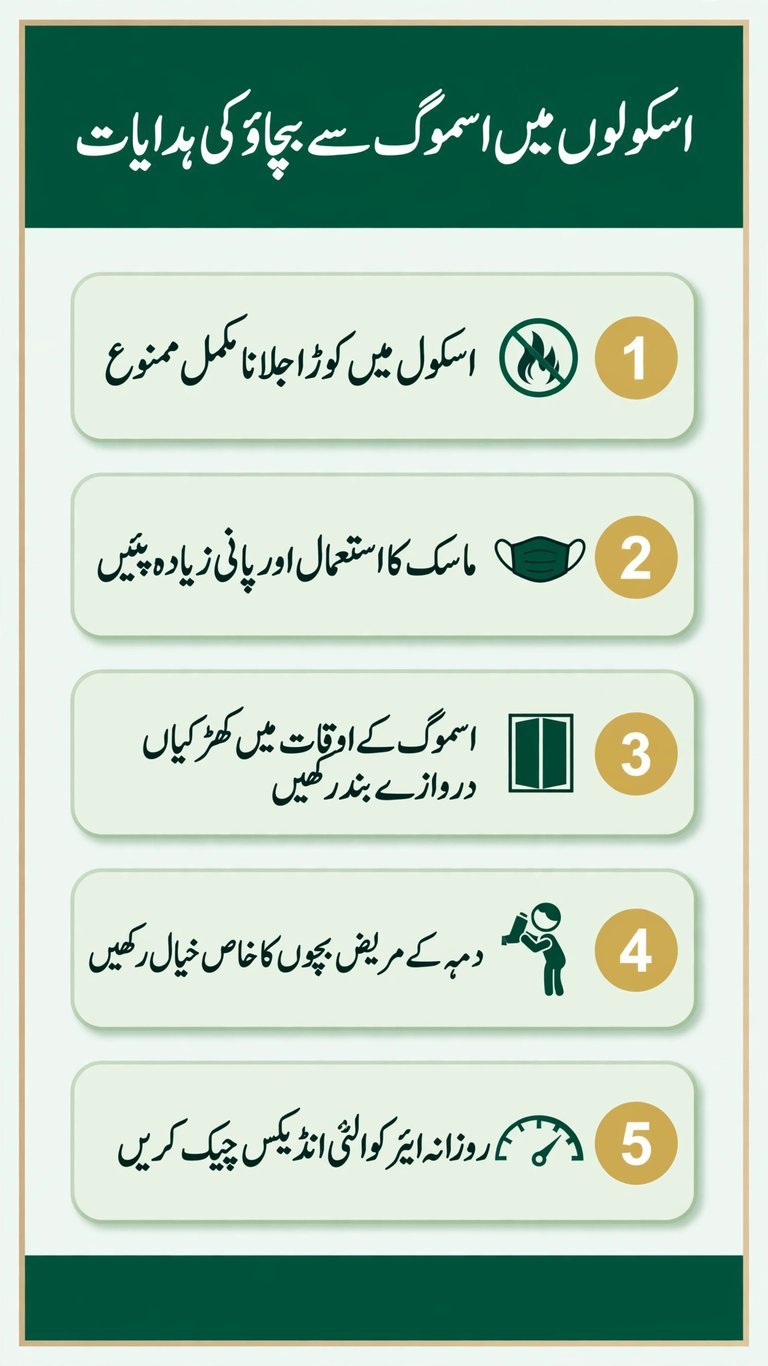
Every winter, thick smog settles over Punjab and makes the air hard to breathe, especially for schoolchildren who spend long hours in classrooms and playgrounds. The Punjab School Education Department has now issued new Punjab School Smog Guidelines for all schools across the province, and the most important order in them is a complete ban on burning garbage and other items within school premises. The guidelines cover awareness, masks, clean classrooms, care for children with asthma, medical readiness and daily monitoring of the Air Quality Index, so that schools can protect students through the smog season.
Guideline Detail
Information
Issuing department
Punjab School Education Department
Applies to
All schools across Punjab
Main order
Complete ban on burning garbage and other items within school premises
Reason
Ongoing smog across the province
Monitoring
Air Quality Index to be checked daily by all schools
Coordination
A focal person in every district to liaise with the Health Department
The Punjab School Smog Guidelines are a set of new directives issued by the Punjab School Education Department for the smog season. They apply to all schools in the province, and they tell schools what to do, and what not to do, while smog levels are high. The guidelines were reported on 13 November 2026, and they treat smog as a health issue for children, not only as a weather problem. Every school is expected to follow them, from large city schools to small schools in towns and villages.
Province-wide order: the guidelines cover all schools across Punjab, with no exception mentioned for any district or school type.
Issued by: the Punjab School Education Department, which is responsible for schools in the province.
Main purpose: to protect students, teachers and staff from the harmful effects of smog during the smog season.
Health focus: the guidelines focus on prevention, awareness and readiness, rather than on punishment.
Daily duty: schools must monitor the Air Quality Index every day and adjust their routines according to the smog situation.
Shared responsibility: students, teachers and parents all have a part to play in following the guidelines.
Parents should understand the spirit of the Punjab School Smog Guidelines clearly. They are not a one-day instruction. They are a routine that schools must follow for as long as smog remains a problem, and they work best when parents also talk to their children about masks, water and staying indoors during heavy smog.
Complete Ban on Burning Garbage in Schools
The clearest order in the Punjab School Smog Guidelines is the complete ban on burning garbage and other items within school premises. Burning garbage adds smoke and harmful particles to air that is already polluted by smog, and it makes the air around a school worse for the very children who study there. Schools must now dispose of their garbage properly instead of burning it.
Total ban: burning garbage inside school premises is completely banned, with no exception mentioned in the announcement.
Other items included: the ban also covers burning other items within school premises, not only garbage.
Proper disposal: schools have been told to make arrangements for the proper disposal of garbage instead of burning it.
Cleaner school air: stopping burning inside schools removes a source of smoke from the place where children spend their day.
Everyone must comply: the ban applies within school premises, so staff, students and visitors must all respect it.
No fine announced: the announcement does not mention any fine amount or penalty for breaking the ban, so no penalty figure should be assumed or quoted.
This ban matters because many schools have, in the past, burned leaves, paper and waste as a quick way to clear it. During smog, that habit directly harms children. The new order makes it plain that garbage in schools must be collected and disposed of properly, and that burning is no longer an option.
Awareness Campaign for Students, Teachers and Parents
The Punjab School Smog Guidelines also order schools to run an awareness campaign for students, teachers and parents about the harmful effects of smog. Many people know that smog is bad, but fewer know exactly how it harms the lungs, the eyes and the heart, or what simple steps reduce that harm. The campaign is meant to close that gap, so that the whole school community understands the risk and the response.
Who is covered: the awareness campaign is for students, teachers and parents together, not for students alone.
Main topic: the harmful effects of smog on health, and how to reduce exposure to it.
Mask use: students will be educated on the use of masks, so they know when and how to wear them.
Drinking water: students will be told to drink plenty of water, which helps the body cope with dry, polluted air.
Staying indoors: students will be advised to avoid unnecessary outdoor exposure during smog.
Simple habits: the guidance focuses on practical daily habits that children and families can actually follow.
Parents have an important role in this campaign. A child who understands why a mask matters is far more likely to wear one, and a parent who reminds the child each morning makes the habit stick. Schools should share the same simple messages with parents, so that the guidance at home matches the guidance at school.
Special Care for Children with Asthma
Children with asthma face the greatest risk during smog, because polluted air can trigger coughing, wheezing and breathing difficulty. The Punjab School Smog Guidelines give special attention to these children and ask schools to take extra care of them while smog lasts.
Special care: schools have been instructed to take special care of children suffering from asthma.
Physical activity: caution must be exercised during physical activities, so that children are not pushed into heavy exercise in polluted air.
Watch for symptoms: teachers should watch for signs of breathing difficulty and act quickly if a child falls ill.
Parents should inform schools: parents of children with asthma should make sure the school knows about the condition and the child’s medicine.
Rest over exertion: during heavy smog, rest and indoor activity are safer for sensitive children than outdoor games and exercise.
No child left out: the guidance protects children with breathing problems without singling them out or excluding them from school life.
This part of the guidelines is a reminder that smog does not affect every child in the same way. A healthy child may only feel irritation in the eyes or throat, while a child with asthma may struggle to breathe. Schools that know which children need extra care can act before a small problem becomes a serious one.
Closed Windows and Clean, Ventilated Classrooms
The Punjab School Smog Guidelines also set out how school buildings should be managed during smog hours. Windows and doors of schools must remain closed during smog hours, so that polluted air stays outside as much as possible. At the same time, classrooms must be kept clean with proper ventilation, because a clean room with fresh air circulation is healthier than a dusty, closed room.
Windows and doors closed: during smog hours, windows and doors of schools must remain closed to limit polluted air entering the building.
Clean classrooms: classrooms must be kept clean, with dust and waste removed regularly.
Proper ventilation: classrooms must have proper ventilation, so that indoor air does not become stale or unhealthy.
Balance matters: closing windows during smog hours and ventilating properly at safer times go together, and schools must manage both.
Garbage disposal: proper arrangements for the disposal of garbage in schools have been mandated, so waste does not pile up inside the school.
Daily routine: cleaning and ventilation should be part of the daily school routine during the smog season, not a one-time effort.
Head teachers should check these arrangements every day. A classroom with closed windows but dirty floors and no ventilation is not a healthy room, and a clean classroom with open windows during peak smog lets the pollution straight in. The guidelines ask schools to get both parts right at the same time.
Medical Records and Emergency Care in Schools
The Punjab School Smog Guidelines also prepare schools for medical emergencies during the smog season. Schools have been directed to maintain emergency medical records of students suffering from respiratory and heart conditions, and teachers must immediately attend to signs of students falling ill. This means that when a child shows symptoms, the school already knows the child’s condition and can respond without delay.
Emergency medical records: schools must maintain emergency medical records of students with respiratory and heart conditions.
Quick response: teachers must immediately attend to signs of students falling ill, rather than waiting or ignoring early symptoms.
Parents should share details: parents should give the school accurate information about a child’s respiratory or heart condition and any medicine the child uses.
Records kept updated: medical records are only useful if they are current, so schools should update them when a child’s condition or medicine changes.
First aid readiness: teachers should know who to contact and what to do first when a student shows signs of illness during smog.
Health over routine: if a child falls ill, caring for the child comes before classwork, tests or any other school routine.
Parents can help by sharing their child’s medical information honestly and in full. A school that knows a child has a heart or breathing condition can keep the child’s record ready, inform the right teacher, and act fast in an emergency. Hiding the condition, by contrast, leaves the school unprepared at the very moment help is needed most.
Focal Person in Every District and Daily AQI Monitoring
The final part of the Punjab School Smog Guidelines deals with coordination and monitoring. A focal person must be designated in every district to liaise with the Health Department, while all schools have been ordered to monitor the Air Quality Index daily. This links each district’s schools with the health authorities, and it gives every school a daily reading on how bad the air is.
District focal person: a focal person must be designated in every district to liaise with the Health Department.
Health Department link: the focal person keeps schools and health authorities in contact during the smog season.
Daily AQI checks: all schools have been ordered to monitor the Air Quality Index daily.
Decisions from data: the daily Air Quality Index reading helps schools decide about outdoor activities, assemblies and sports during smog.
Consistent monitoring: the Air Quality Index must be checked every day, not only on days when the smog looks visibly worse.
Province-wide system: the focal person and daily monitoring together create one system for the whole province, rather than leaving each school to act alone.
The daily Air Quality Index check is a small task with a large benefit. A school that knows the air quality each morning can keep children indoors on the worst days, allow limited outdoor activity on better days, and warn parents when conditions are dangerous. Without that daily check, schools would be guessing, and children would pay the price.
Important Points Parents and Schools Should Know
The Punjab School Smog Guidelines are clear on what schools must do, but there are also things the announcement does not say, and those gaps matter. No fine amount has been announced for burning garbage in schools, and no deadline has been announced for any part of the guidelines, because they are standing instructions for the smog season rather than a dated application or registration process. Parents and schools should not quote a penalty figure or a last date that was never announced.
No fine announced: the source announcement mentions no fine amount or penalty, so no penalty figure is given in this article.
No deadline announced: no deadline or last date has been announced for the guidelines, which are orders for the smog season.
Applies to all schools: the guidelines cover all schools across Punjab, with no exception mentioned in the announcement.
Parents must cooperate: masks, water, indoor time and medical information all need parents to play their part at home.
Check the source: the full report can be read on ProPakistani, and the source link is given in the details table at the top of this article.
Follow school instructions: each school may share its own daily arrangements under the guidelines, and parents should follow the instructions of their child’s school.
Schools that follow the guidelines fully will be safer places during smog. The ban on burning garbage removes smoke from the school itself, the awareness campaign teaches children how to protect themselves, and the medical records and daily Air Quality Index checks prepare schools for the days when the air is at its worst. Together, these steps give Punjab’s schoolchildren a real shield against smog.
Campaign for students, teachers and parents on smog harms
Student health
Masks, plenty of water, avoid unnecessary outdoor exposure
Children with asthma
Special care, caution during physical activities
School building
Windows and doors closed during smog hours; clean classrooms with proper ventilation
Medical readiness
Emergency medical records for respiratory and heart conditions; teachers to attend immediately to illness
Coordination
Focal person in every district to liaise with the Health Department
Air quality
Air Quality Index monitored daily by all schools
Conclusion
The Punjab School Smog Guidelines give Punjab’s schools a clear plan for the smog season: stop burning garbage inside school premises, teach children and parents how smog harms health, encourage masks and plenty of water, keep children with asthma safe, close windows during smog hours while keeping classrooms clean and ventilated, keep emergency medical records ready, and check the Air Quality Index every day. With a focal person in every district linking schools to the Health Department, the province now has one coordinated system instead of scattered efforts. Parents should support their child’s school by sending children with masks, sharing medical information honestly, and keeping children indoors during heavy smog. If schools and families follow these guidelines together, children can keep learning through the smog season with far less risk to their health.
FAQs
What are the Punjab School Smog Guidelines? They are new directives issued by the Punjab School Education Department for all schools across Punjab during the smog season. They include a complete ban on burning garbage within school premises, an awareness campaign, mask use, clean classrooms, care for children with asthma, medical readiness and daily Air Quality Index monitoring.
Is burning garbage banned in Punjab schools? Yes. The Punjab School Smog Guidelines impose a complete ban on burning garbage and other items within school premises, and schools must make proper arrangements for garbage disposal instead.
What should students do to protect themselves from smog? Students should wear masks, drink plenty of water and avoid unnecessary outdoor exposure during smog. Schools will educate students on these habits as part of the awareness campaign ordered under the Punjab School Smog Guidelines.
How will schools protect children with asthma during smog? Schools must take special care of children suffering from asthma and exercise caution during physical activities. Schools must also maintain emergency medical records of students with respiratory and heart conditions, and teachers must immediately attend to signs of students falling ill.
Must schools check the Air Quality Index every day? Yes. All schools have been ordered to monitor the Air Quality Index daily, and a focal person must be designated in every district to liaise with the Health Department.
Is there a fine for burning garbage in schools? No fine amount has been announced in the source report, so no penalty figure can be quoted. The announcement states the ban itself, without mentioning any fine or penalty.
Where can I read the original report? The original report was published by ProPakistani on 13 November 2026. The source link is given in the details table at the top of this article.
Shahzad Sahil is the editor of lahorejobs24.com, covering government jobs, private jobs, bank jobs, results and education news for Lahore and Punjab, with information verified from official sources.